
Mold Remediation in Perris
24/7 mold remediation in Perris and surrounding areas. IICRC-certified, insurance billing accepted. Call (951) 479-7038.
A musty smell that won’t go away after a slow roof leak, a discolored patch spreading behind the baseboard, or a bathroom ceiling stain that keeps coming back no matter how many times it’s painted over: these are the signs that point to active mold growth rather than a problem a surface clean will solve. Once moisture sits inside drywall, insulation, or subflooring for more than a day or two, colonization can begin, and by the time it’s visible, there’s usually more growing behind the material than in front of it. Thunder Restoration provides mold remediation in Perris built around containment, removal, and verification, not just spraying a bleach solution and hoping it holds.
What Mold Remediation actually involves
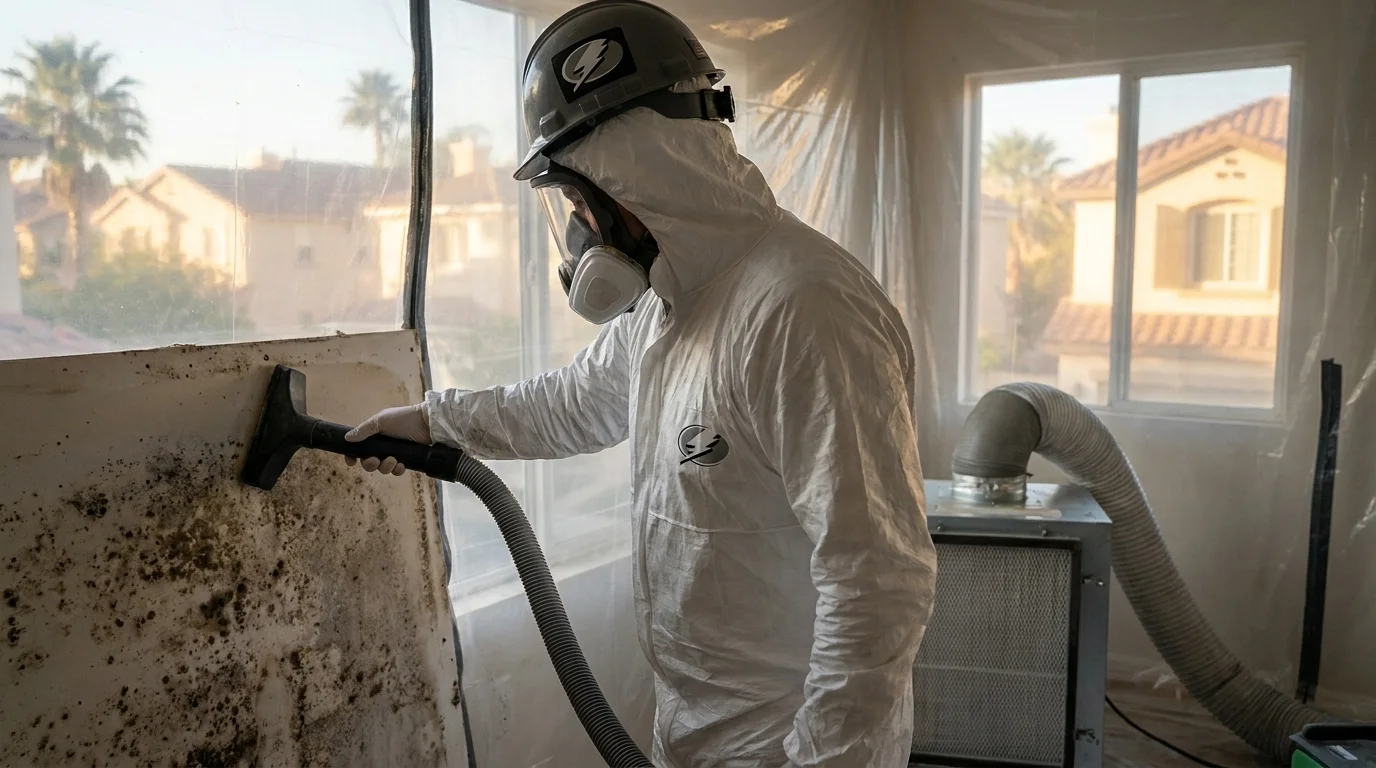
Mold remediation is the physical removal of mold-affected material and the microbial load that comes with it, done under containment so spores don’t spread to unaffected rooms during the work. This is different from a surface cleaning service: porous materials like drywall, carpet pad, and insulation that have been colonized typically can’t be sanitized back to a clean state, they have to be removed, bagged, and replaced. Depending on the scope, the work может include setting up poly sheeting and negative air pressure, running HEPA air scrubbers for the duration of the project, demolishing and disposing of affected building materials, and treating the remaining structural wood with an EPA-registered antimicrobial. Smaller jobs confined to one bathroom or closet can often be completed in a day or two. Larger jobs involving an attic, crawlspace, or multiple rooms following a slow undetected leak can run a week or more, particularly if structural drying has to happen before remediation can finish.
Our process
- Assessment and scope documentation. We identify the source of the moisture feeding the growth, measure the visible extent, and document conditions with photos before any material is disturbed. This record matters for insurance and for confirming the job is complete later.
- Containment setup. Affected areas are isolated with physical barriers and, on larger jobs, negative air pressure so spores don’t travel into the HVAC system or adjoining rooms while work is underway.
- Material removal and HEPA filtration. Mold-affected drywall, insulation, flooring, or trim is removed and bagged inside containment. HEPA air scrubbers and HEPA vacuums run continuously to pull airborne spores and settled dust out of the work area.
- Antimicrobial treatment. Remaining structural surfaces, studs, subfloor, framing, are treated with an EPA-registered antimicrobial to address residual microbial activity before any rebuild begins.
- Clearance check. Before we call a job finished, the containment area is visually inspected and, when the scope calls for it, a third-party air sample can confirm spore counts have returned to a normal range for the space.
What separates a good mold remediation response from a bad one
The most common mistake on a mold job isn’t the removal, it’s skipping the moisture source. If a slow pipe leak or a roof flashing issue isn’t fixed first, the mold comes back in the same spot within weeks regardless of how thorough the cleanup was. A second common shortcut is working without containment on anything beyond a tiny spot, which can push spores into clean areas of the home and turn a one-room problem into a multi-room one. Adjusters reviewing a mold claim generally want to see documented moisture readings, photos of the affected material before demolition, and a clear scope tying the mold back to a covered water event, so thorough documentation at every stage isn’t paperwork for its own sake, it’s what makes a claim defensible.
What does Mold Remediation cost?
Costs vary with how much material has to come out, whether containment covers one room or several, and whether a crawlspace or attic is involved. These figures are typical industry ranges, not a quote: every loss is different, and Thunder Restoration provides a written scope before any work begins so there are no surprises once demolition starts. Homeowners insurance will sometimes cover mold remediation when it’s a direct result of a covered water loss, such as a burst pipe, but typically excludes mold from gradual leaks or long-term humidity, so it’s worth confirming coverage specifics with your carrier before work starts.
| Scenario | Typical range |
|---|---|
| Small bathroom or closet, isolated spot | $500 - $1,500 |
| Single room following a water event | $1,500 - $4,000 |
| Multiple rooms or an HVAC-involved case | $4,000 - $10,000 |
| Attic or crawlspace remediation | $3,000 - $8,000 |
| Large-scale or whole-structure remediation | $10,000+ |
Seasonal & regional considerations
Perris sits in an inland valley with hot, dry summers, which actually works in a homeowner’s favor since low ambient humidity slows regrowth once a space is dried out. The risk window is narrower but sharper: it tends to follow winter storm leaks, irrigation line breaks near stucco foundations, or a slow AC condensate leak running through summer when units work hardest. Homes built before the 1990s around the Perris area more often have older plumbing and roofing details that let water intrude slowly for months before anyone notices a stain, which is usually when remediation scope turns out larger than expected.
Service area
Thunder Restoration handles mold remediation throughout Perris and nearby communities including Moreno Valley, Menifee, Hemet, and Sun City. Local housing stock and soil conditions vary by neighborhood, so inspections are scoped to the specific property rather than a generic assessment.
If you’re seeing discoloration, smelling a persistent musty odor, or recovering from a water event that wasn’t dried out fast enough, request an air quality test and scope review before the growth spreads further into the structure. Call (951) 479-7038 to schedule an assessment.
Frequently Asked Questions
Does homeowners insurance cover mold remediation?
What level of mold remediation requires containment?
Do you need to do air sampling before and after remediation?
Can mold-affected drywall or carpet be cleaned instead of removed?
What should I do while I'm waiting for a mold remediation appointment?
Looking for the best mold remediation company in Perris?
Thunder Restoration provides licensed and insured mold remediation in Perris, CA and the surrounding area, and has served local property owners since 2007. Customers rate us 4.5 out of 5 stars across 46 Google reviews. We answer calls 24/7 — call (951) 479-7038 for immediate help.
Need Mold Remediation now?
We respond 24/7 across Perris and surrounding CA cities.
Related Coverage
- Our Restoration Services
- Contact Thunder Restoration
- Serving All of Perris
- Restoration Services in Menifee
- Restoration Services in Murrieta
- Restoration Services in Riverside
- Restoration Services in Moreno Valley
- Mold Remediation in Canyon Lake
- Mold Remediation in Hemet
- Mold Remediation in Moreno Valley
- Mold Remediation in Murrieta
- Mold Remediation in Riverside
- Mold Remediation in Temecula
- Mold Remediation in Lake Elsinore
- Mold Remediation in Winchester
- How To Choose a Restoration Company in Perris (Without Getting Burned)
- How To Test for Mold in Your Home (DIY Kits vs a Pro Inspection)
- 7 Signs You Have Hidden Mold (and What To Do Next)