
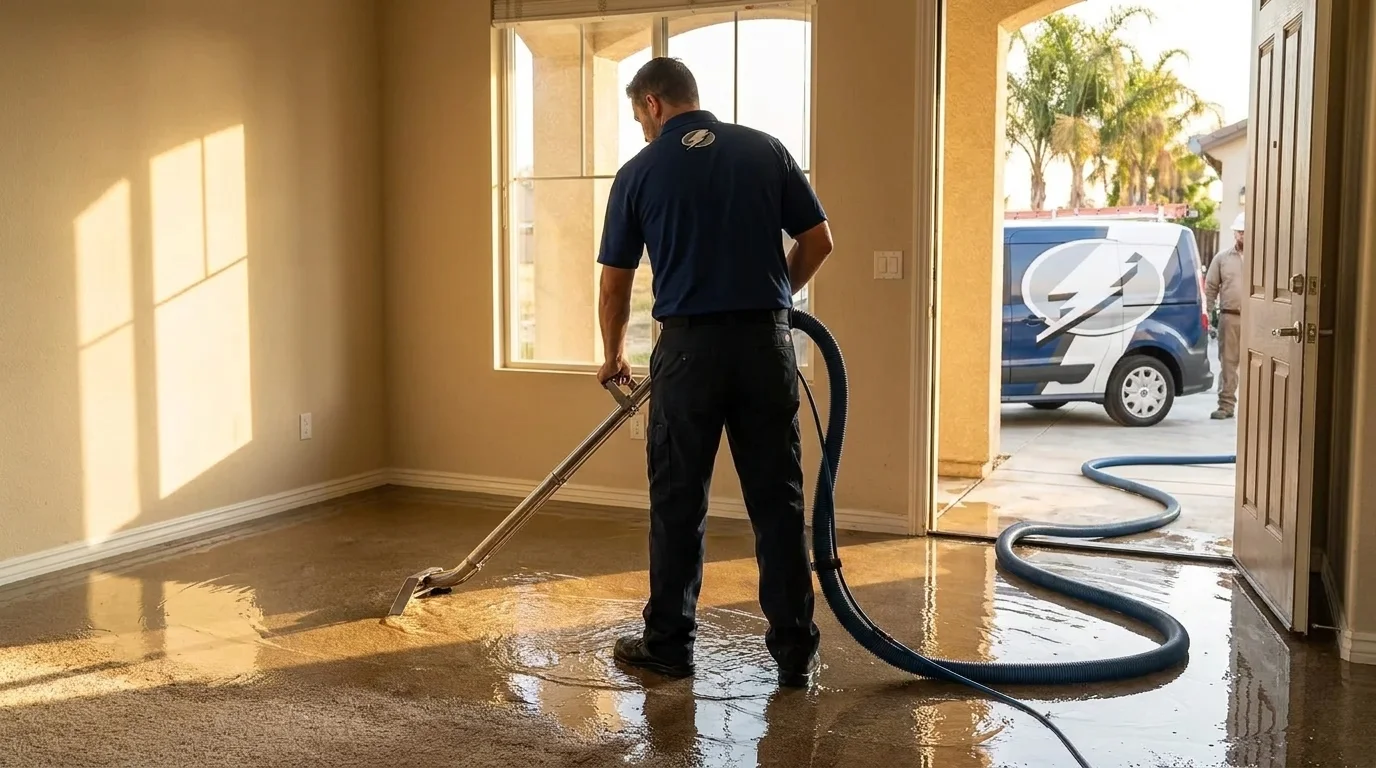
24/7 Emergency Flood Damage Restoration in Perris
24/7 emergency flood damage restoration in Perris and surrounding areas. IICRC-certified, insurance billing accepted. Call (951) 479-7038.
Flood damage in Perris? Call now, we answer 24/7 and send a crew to start extraction and assessment the same day.
Flood water rarely behaves like a plumbing leak. It arrives fast, carries soil, debris, and sometimes sewage backflow from overwhelmed storm drains, and it finds every low point in a house, baseboards, HVAC returns, the gap under slab doors, before anyone realizes how far it’s traveled. By the time standing water is visible in a living room, it has often already wicked two or three feet up drywall and soaked into subfloor that looks dry on top. Flood damage restoration is the work of finding all of that, not just the puddle you can see.
What Flood Damage Restoration actually involves
A flood response starts with identifying the water’s classification, groundwater and storm runoff are typically treated as contaminated (Category 3) because of what they pick up on the way in: soil bacteria, chemicals, sometimes sewage. That changes everything downstream, from what materials can be dried versus must be removed, to what PPE the crew wears. Expect submersible and truck-mount extraction for standing water, selective demolition of flood-contaminated drywall and insulation (usually cut at 12 to 24 inches above the water line), antimicrobial application on structural framing, and then high-capacity air movers and desiccant dehumidifiers running for several days with daily moisture readings logged against the IICRC S500 drying standard. Flooring is almost always a separate conversation, laminate and most carpet pad don’t survive contaminated water and get replaced rather than dried.
Our process
- Water classification and safety check - confirm the source and contamination level, check for electrical hazards and structural risk before anyone enters standing water.
- Extraction - pump and wet-vac standing water out, prioritizing rooms where water is actively migrating toward unaffected areas.
- Contaminated material removal - cut and remove flood-soaked drywall, insulation, and flooring that can’t be safely dried, bagged and disposed of per category guidelines.
- Structural drying and antimicrobial treatment - set air movers and dehumidifiers, treat exposed framing and subfloor, and monitor moisture content daily until readings return to normal.
- Documentation handoff - photos, moisture logs, and a written scope get compiled for your insurance claim and for reconstruction planning if rebuild is needed.
What separates a good flood damage response from a bad one
The most common mistake is treating a flood like a clean-water leak: drying materials that should have been removed because they were in contact with contaminated water. That decision gets revisited later when an adjuster or a follow-up inspection finds mold growth inside a wall cavity that was dried instead of opened. A second mistake is incomplete moisture mapping, checking the obvious wet spots but skipping behind cabinets, under built-in shelving, or inside the wall plate at the slab. Adjusters look for daily drying logs, photos of the water line and affected materials before demolition, and a clear basis for what got removed versus dried in place. Work that’s billed to insurance without that documentation tends to get pushed back or underpaid.
What does Flood Damage Restoration cost?
Costs vary widely based on how much water intruded, how long it sat before extraction started, and whether contamination requires material removal versus drying in place. Every loss gets a written scope before work begins because two floods that look similar from the street can involve very different square footage of affected material underneath. Homeowners insurance typically covers sudden flood-adjacent losses like storm-driven water intrusion or sewer backup when those perils are named in the policy, though standalone flood insurance is a separate product for many homeowners and worth checking before you assume coverage.
| Scenario | Typical range |
|---|---|
| Single room, water extracted within hours | $1,500 - $4,000 |
| Multi-room flooding with some drywall removal | $4,000 - $10,000 |
| Whole-floor flood with flooring and drywall replacement | $10,000 - $25,000 |
| Contaminated floodwater requiring extensive demolition | $15,000 - $35,000+ |
| Basement flood with saturated framing and finished walls | $8,000 - $20,000 |
Seasonal & regional considerations
Perris sits in a valley where winter storm systems can drop a lot of rain in a short window onto ground that’s often hard and dry from months of heat, so runoff doesn’t absorb the way it would elsewhere, it sheets toward low points fast. Older slab-on-grade homes in the area are especially prone to water finding its way in through door thresholds and slab penetrations during these events. Flash flood conditions in the broader Inland Empire region also mean storm drains and retention basins can back up, which is part of why floodwater here often carries more contamination risk than a simple rain soak would suggest.
Service area
Thunder Restoration responds to flood damage throughout Perris and the surrounding Inland Empire, including Moreno Valley, Menifee, Hemet, and Lake Elsinore, with licensed and OSHA-trained crews (license #902886) available around the clock.
If your home has standing water or a wall line that’s darkening from the bottom up, don’t wait for it to dry on its own, call (951) 479-7038 to schedule your flood damage assessment and get extraction started before contamination sets deeper into the structure.
Frequently Asked Questions
Does homeowners insurance cover flood damage restoration?
How do you decide what gets dried versus removed after a flood?
How long does flood damage restoration typically take?
What should I do while waiting for a flood restoration crew to arrive?
Why does floodwater get treated differently than a burst pipe or appliance leak?
Looking for the best flood damage restoration company in Perris?
Thunder Restoration provides licensed and insured flood damage restoration in Perris, CA and the surrounding area, and has served local property owners since 2007. Customers rate us 4.5 out of 5 stars across 46 Google reviews. We answer calls 24/7 — call (951) 479-7038 for immediate help.
Need Flood Damage Restoration now?
We respond 24/7 across Perris and surrounding CA cities.