
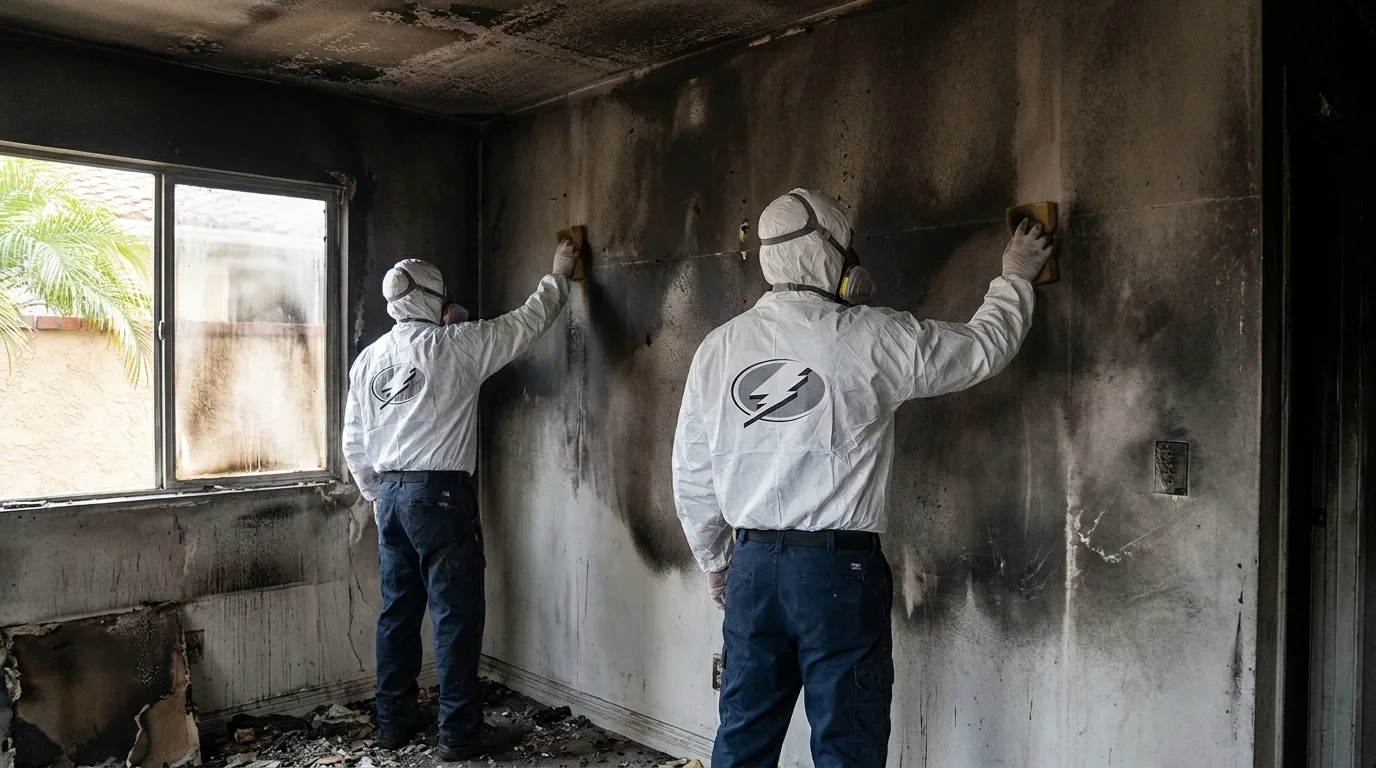
24/7 Emergency Fire Damage Restoration in Perris
24/7 emergency fire damage restoration in Perris and surrounding areas. IICRC-certified, insurance billing accepted. Call (951) 479-7038.
Fire damage emergency in Perris? Call (951) 479-7038 now. We answer 24/7 and can begin securing the structure and documenting losses before smoke residue sets permanently into drywall, cabinetry, and HVAC ductwork.
A house fire is rarely contained to the room where it started. Smoke travels through return air vents and settles on cool surfaces throughout the home, soot residue turns acidic within hours and starts etching metal and glass, and water from firefighting efforts soaks into framing right alongside the char. The damage you can see is often the smaller part of the problem.
What Fire Damage Restoration actually involves
Fire damage restoration covers the structural and material side of recovery after a fire: assessing what can be cleaned versus what has to be removed, neutralizing soot before it bonds permanently to surfaces, and getting the structure back to a condition a contractor can safely rebuild from. This is different from a general cleanup job. Soot is acidic and corrosive, and the type of soot left behind (protein-based from a kitchen fire versus synthetic soot from burning plastics and electronics) changes which cleaning agents and equipment actually work. Structural members that look fine can have reduced integrity from sustained heat exposure, and that has to get flagged before any finish work starts. Timelines vary with the size of the fire, but soot characterization and the first rounds of cleaning typically happen in the first days on site, with odor treatment and contents work running longer depending on what’s salvageable.
Our process
- Site safety and damage assessment. We check structural stability, document every affected room and material with photos for the claim file, and identify which surfaces are salvageable versus total loss.
- Soot characterization. We identify whether the residue is dry protein soot, wet smoke, or synthetic soot from burned plastics and synthetics, since each requires a different cleaning chemistry and sequence.
- Thermal fogging and odor treatment. We use thermal fogging to drive deodorizing agents into the same pore structure and HVAC pathways that smoke penetrated, reaching odor sources that surface cleaning can’t touch.
- Ozone or hydroxyl treatment. Where odor has penetrated porous materials, we run ozone or hydroxyl generators in a sealed space to break down smoke molecules at the source rather than masking them.
- Contents pack-out and structural cleaning. Salvageable belongings are inventoried, packed out, and cleaned off-site while we clean and seal structural surfaces so a contractor can safely proceed with repairs.
What separates a good fire damage response from a bad one
The most common mistake is treating fire damage as a surface cleaning job. Soot left untreated for even a short time becomes progressively harder to remove as it bonds with surfaces under heat and humidity, and odor that’s only masked instead of chemically neutralized comes back, sometimes months later once the weather warms up and residual smoke compounds off-gas again. Adjusters pay close attention to whether structural members were actually tested for heat damage versus just wiped down and painted over, and whether HVAC ductwork was cleaned or just ignored because it wasn’t visibly charred. A written scope that separates cleanable materials from materials that need replacement protects both the homeowner and the claim, because it gives the adjuster something specific to evaluate instead of a vague “smoke damaged” label applied to the whole house.
What does Fire Damage Restoration cost?
Costs depend heavily on how much of the structure was exposed to heat versus smoke only, how far soot traveled through the HVAC system, and how many contents need pack-out and cleaning. These are typical industry ranges, not a quote: every fire behaves differently, and Thunder Restoration provides a written scope of work before any restoration begins.
| Scenario | Typical range |
|---|---|
| Smoke odor only, no visible soot | $500 - $1,500 |
| Single room, light soot and smoke | $2,000 - $6,000 |
| Multi-room smoke and soot damage | $6,000 - $20,000 |
| Structural fire with charring | $20,000 - $60,000+ |
| Whole-home fire loss | $60,000 and up |
Homeowners insurance typically covers fire damage restoration under the dwelling and contents portions of a standard policy, and Thunder Restoration works directly with insurance carriers to document the loss and support the claim.
Seasonal & regional considerations
Perris sees hot, dry summers and Santa Ana wind events that raise both wildfire risk and the speed at which indoor fires spread once they start. Low humidity here also means smoke odor can linger in porous materials like drywall and insulation longer than it would in a damper climate, which is part of why odor treatment is rarely a one-pass job in this region.
Service area
Thunder Restoration responds to fire damage losses in Perris and surrounding Riverside County communities, including Moreno Valley, Menifee, Hemet, and Sun City.
If a fire has touched your home or business, don’t wait on soot and odor to set deeper into the structure. Call Thunder Restoration to begin smoke and soot removal and get a documented scope started for your insurance claim.
Frequently Asked Questions
Does homeowners insurance cover fire damage restoration?
What's the difference between protein soot and synthetic soot, and why does it matter?
Can smoke odor really get removed, or does it just get covered up?
What happens to my belongings during fire damage restoration?
How soon after a fire should restoration work start?
Looking for the best fire damage restoration company in Perris?
Thunder Restoration provides licensed and insured fire damage restoration in Perris, CA and the surrounding area, and has served local property owners since 2007. Customers rate us 4.5 out of 5 stars across 46 Google reviews. We answer calls 24/7 — call (951) 479-7038 for immediate help.
Need Fire Damage Restoration now?
We respond 24/7 across Perris and surrounding CA cities.
Related Coverage
- Our Restoration Services
- Contact Thunder Restoration
- Serving All of Perris
- Restoration Services in Menifee
- Restoration Services in Murrieta
- Restoration Services in Riverside
- Restoration Services in Moreno Valley
- 24/7 Emergency Fire Damage Restoration in Hemet
- 24/7 Emergency Fire Damage Restoration in Lake Elsinore
- 24/7 Emergency Fire Damage Restoration in Menifee
- 24/7 Emergency Fire Damage Restoration in Moreno Valley
- 24/7 Emergency Fire Damage Restoration in Murrieta
- 24/7 Emergency Fire Damage Restoration in Riverside
- 24/7 Emergency Fire Damage Restoration in Temecula
- 24/7 Emergency Fire Damage Restoration in Good Hope
- 24/7 Emergency Fire Damage Restoration in Romoland
- 24/7 Emergency Fire Damage Restoration in Winchester
- 24/7 Emergency Fire Damage Restoration in Woodcrest
- How To Choose a Restoration Company in Perris (Without Getting Burned)
- The Fire Damage Restoration Process, Explained