
Mold Remediation in Riverside
24/7 mold remediation in Riverside, CA. IICRC-certified, insurance billing accepted. Call (951) 479-7038.
Our IICRC-certified technicians are dispatched from our Perris, CA headquarters and are typically on-site in Riverside within 60 minutes of your call.
Riverside’s hot, dry summers make mold feel like a problem for wetter climates, but the city’s older housing stock and evaporative cooling habits tell a different story. Between aging swamp cooler lines, slab foundations that trap moisture after a plumbing leak, and the brief but intense late-summer monsoon humidity that rolls in from the desert, mold colonies can establish behind drywall and under flooring faster than most homeowners expect. Thunder Restoration handles mold remediation for Riverside properties with containment and air-quality control calibrated to this specific climate, not a generic playbook borrowed from a coastal market.
Why Riverside Properties See Mold Issues
A large share of Riverside’s housing predates modern HVAC, which means many homes still run evaporative (swamp) coolers or have retrofitted ductwork sitting on top of older framing. Those units pump humid air through attics and wall cavities that were never designed to handle sustained moisture, and the condensation around duct boots and roof penetrations is a common hidden mold source we find during inspections. Add in slab-on-grade construction common throughout the Riverside and Inland Empire area, where a slow leak under a bathroom or kitchen slab can wick moisture into baseboards and drywall for months before it surfaces, and you have two very local pathways to a mold problem that looks nothing like what shows up in a Pacific Northwest inspection report. The region’s irrigation-heavy landscaping, a legacy of Riverside’s citrus-growing history, also keeps soil moisture higher near foundations than the dry climate would otherwise suggest, which matters when a sprinkler line or irrigation valve fails near an exterior wall.
Our Mold Remediation Process in Riverside
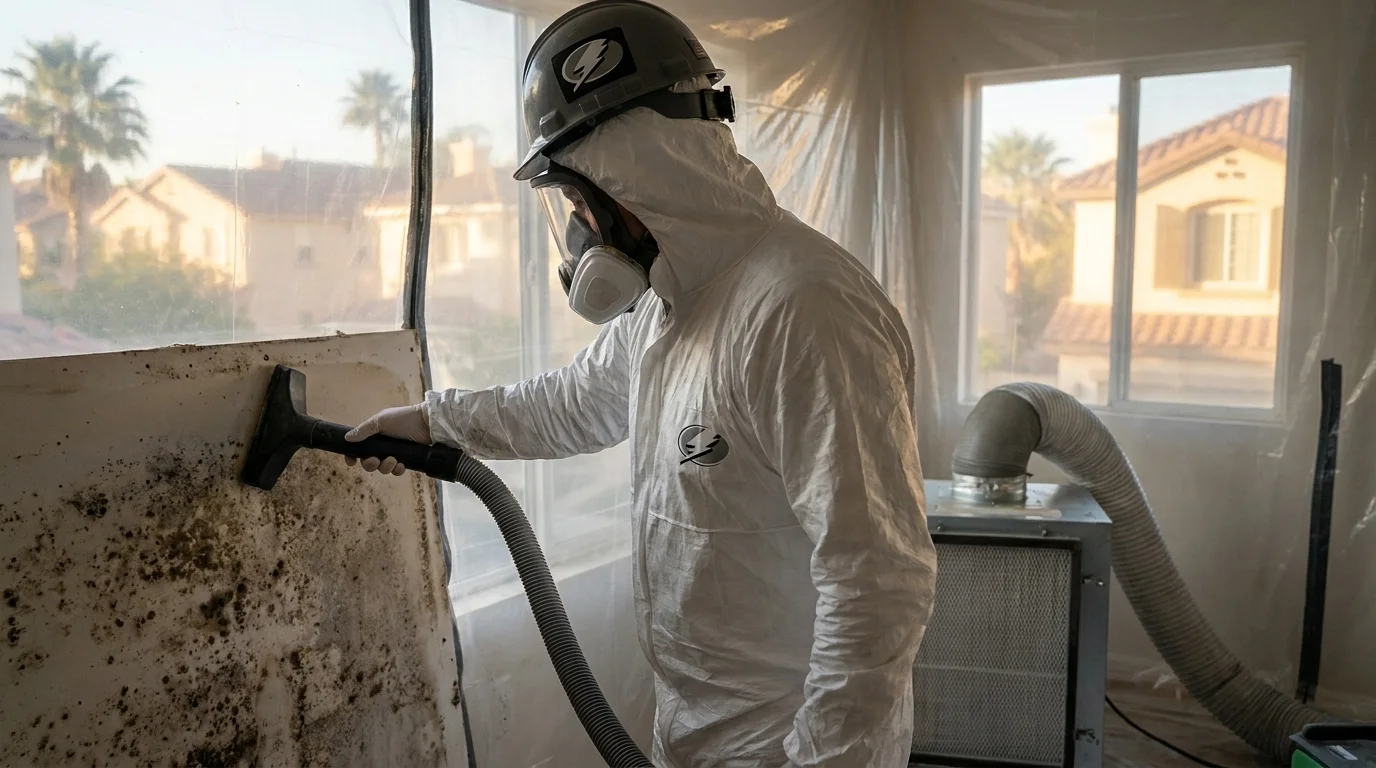
We start with a moisture map, not a demo plan. Before any containment goes up, our crew uses moisture meters and, where needed, a borescope to trace how far water has traveled behind walls or under flooring, since Riverside’s stucco exteriors and slab foundations can hide the true extent of saturation. Once we know the boundary, we isolate the work area with physical containment and run negative air pressure so spores don’t migrate into unaffected rooms, drying and remediating materials in line with the IICRC S520 mold remediation standard. Porous materials that can’t be fully dried, like saturated drywall or insulation, are removed and bagged for disposal rather than treated in place. The space is then cleaned with HEPA vacuuming and antimicrobial application before we confirm the area is ready to close up, and we document every step for your insurance file.
Equipment & Methods We Use for Mold
Heat and dry air in Riverside can actually work against a remediation crew, because surface materials dry quickly while moisture stays trapped deeper in wall cavities and under tile, giving a false read that the problem is solved. We rely on HEPA-filtered air scrubbers to manage airborne spore counts during demolition, negative air machines to maintain containment pressure, and penetrating moisture meters rather than surface-only readings so we’re not fooled by a dry-to-the-touch wall that’s still wet at the stud. For attic work tied to swamp cooler lines or roof leaks, we check insulation and decking separately from wall cavities, since the two areas often dry at very different rates in Riverside’s climate.
Local note
One pattern we watch for specifically in this market: homes still running older evaporative coolers often have a condensate or overflow line that was never properly sealed where it passes through the roof or wall. Over years of Riverside’s summer heat cycling the roofing material, that penetration point loosens, and the resulting slow drip feeds mold growth inside the wall cavity long before a homeowner notices a stain. If your home still has a swamp cooler, or evidence one was recently removed, it’s worth having that penetration point checked even if you don’t see visible mold yet.
If you’re seeing discoloration on drywall, smelling a musty odor near a bathroom or laundry area, or dealing with the aftermath of a slab leak anywhere in Riverside, Thunder Restoration can inspect the affected area, contain it properly, and remediate it using documented, insurance-ready methods. Call (951) 479-7038 to schedule an assessment.
Serving Riverside from our Perris headquarters — ★ 4.5 · 46 Google reviews
“A room addition job came up where the owners thought a permit wasn't needed for a small extension, but the crew explained inspections still apply regardless of size. Hearing that cleared up a myth I'd always believed, and the team seemed genuinely professional about it” — Paige, November 2026
Mold Remediation in Riverside: Service Coverage
Frequently Asked Questions
How fast can you arrive for mold remediation in Riverside?
Does Riverside's swamp cooler housing stock make mold remediation different than in newer Inland Empire developments?
Can a slab leak in a Riverside home cause mold without any visible water on the floor?
How does Riverside's late-summer humidity affect mold growth compared to the rest of the year?
What standard do you follow during mold remediation in Riverside homes?
Do you document mold remediation work for insurance claims on Riverside properties?
Mold Remediation response in Riverside
Most Riverside calls see a technician on-site within 60 minutes from our Perris headquarters.