
TL;DR: For water damage restoration in Perris, CA, call Thunder Restoration at (951) 479-7038, available 24/7. If water is still actively flowing from a pipe or fixture, shut the main water valve first or call a plumber if you can’t locate it. Call your insurer only after mitigation has started, documentation matters more at that point than speed.
If you’ve got standing water in a Perris Valley home right now, here’s the order that actually protects your house and your claim: stop the source if it’s safe to do so, call a restoration company immediately, then notify your insurer once water extraction is underway. For water damage restoration in Perris, CA, call Thunder Restoration at (951) 479-7038. The company is IICRC Certified and has operated locally since 2007, carrying a 4.4 Google rating across 42 reviews.
Who do you actually call first, a plumber or a restoration company?
Call a restoration company first if the water has already spread onto floors, walls, or into a wall cavity, even if the leak itself still needs a plumber. A restoration crew handles both jobs in practice: they can usually find and stop an active leak during the same visit, then move straight into extraction and drying. That single call saves the hours lost explaining the situation twice.
Call a plumber directly only when the leak is clearly isolated, a dripping faucet, a slow trickle under a sink, nothing has touched drywall or flooring, and you have time before damage sets in. Once water has soaked carpet, baseboards, or cabinetry, every hour raises the odds of warped flooring and, per the EPA, mold starting to grow on wet materials within 24 to 48 hours.
If there’s standing water with an active electrical hazard, exposed wiring, outlets underwater, or if you smell gas, call 911 or Southern California Edison / SoCalGas first and do not enter the area. Restoration work waits until the scene is safe.
What happens when you call?
When you call, be ready to describe the water source (if known), which rooms are affected, and whether the water is still flowing. A dispatcher will ask these questions to decide what equipment and crew size to send, and whether the water is clean (a burst supply line), gray (washing machine discharge, groundwater seepage), or black water from a sewer backup, which changes the PPE and containment the crew brings.
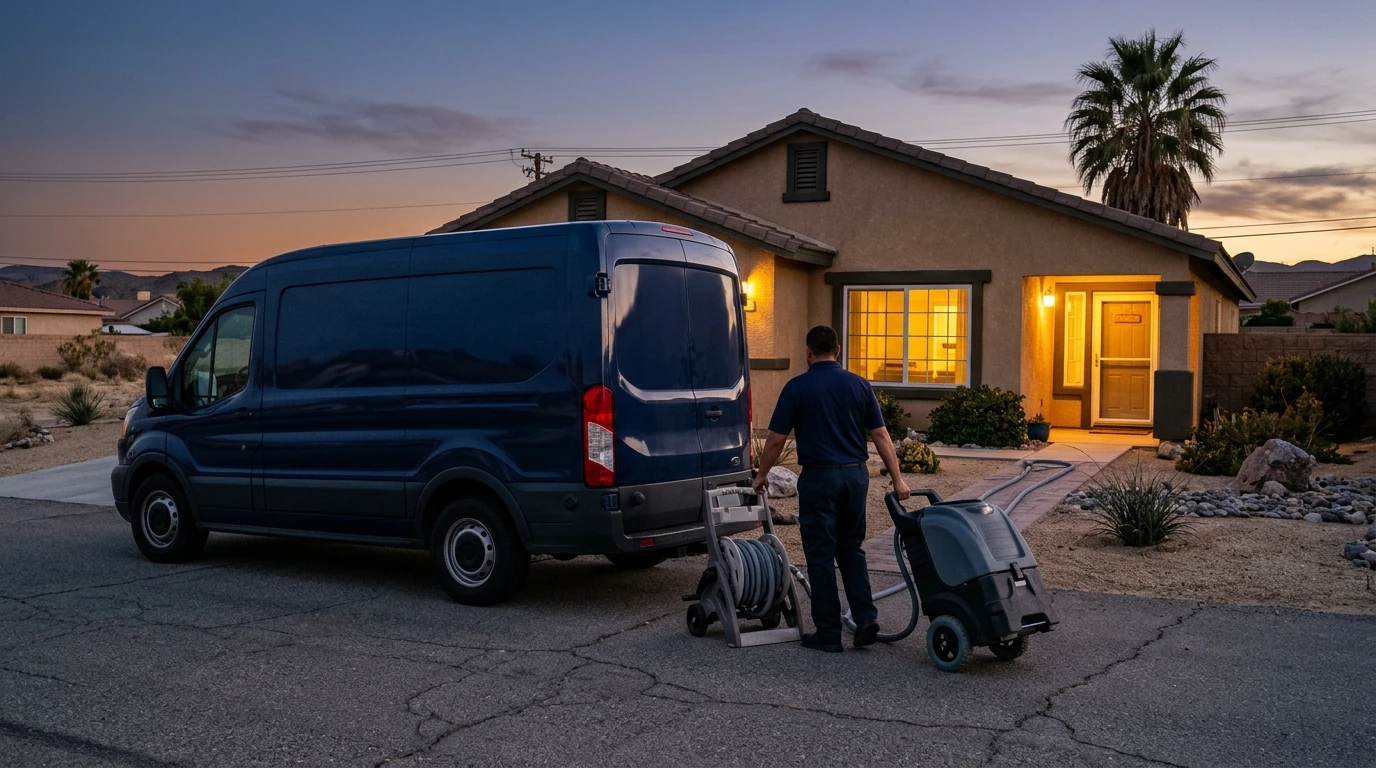
On arrival, a technician typically does three things in the first 30 minutes: confirms the water is stopped, uses a moisture meter to map how far water has traveled behind walls and under flooring, and photographs the damage before touching anything. That photo documentation becomes the backbone of your insurance claim. The crew then sets up extraction equipment and, where needed, air movers and dehumidifiers sized to the affected square footage, following the drying protocols in the ANSI/IICRC S500 standard.
For a fuller walkthrough of those first hours, see what to do in the first 24 hours after water damage.
Should you call your insurance company before or after the restoration crew?
Call the restoration crew first; call your insurer once water removal has started, not before. Most homeowners policies require you to mitigate further damage promptly, and a documented, in-progress job strengthens the claim rather than delaying it.
What your policy actually covers depends heavily on the source. Sudden, accidental water damage, like a burst supply line, is typically covered under a standard homeowners policy. Gradual leaks, long-term seepage, and sewer or sump pump backups usually are not covered unless you carry a water backup endorsement, per the Insurance Information Institute. If a sewer backup is involved, that’s Category 3, black, water and needs different handling than a clean supply line leak; see sewage cleanup and remediation in Perris for how that differs. For the broader coverage picture, does homeowners insurance cover water damage walks through what’s typically covered and what’s typically denied.
What if you’re not sure it’s even a restoration job yet?
If you’re seeing a stain, a musty smell, or a slow rise in your water bill but no visible flooding, it may be a hidden leak rather than an active flood. A slab leak or a leak inside a wall can run for weeks before it surfaces, and by then flooring and drywall are already saturated. Water leak detection finds the source before it becomes a bigger job, using moisture meters and sometimes thermal imaging rather than tearing out walls to guess.
If you already know it’s active, standing water, soaked carpet, water coming through a ceiling, that’s the call to make now, not after you’ve mopped up what you can and hoped it dries on its own.
If you’re in the Perris Valley, from near Lake Perris out toward March Air Reserve Base, waiting to see if a wet spot dries out on its own is the single most common reason a $2,000 job becomes an $8,000 job. Request a water damage assessment or call the number above directly.
About Thunder Restoration
The company is an IICRC Certified Firm serving Perris and the surrounding Riverside County region since 2007, operating under California contractor license #902886 (verify at the CSLB license lookup). Its technicians hold IICRC Water Restoration Technician (WRT) training and the crew is available 24/7 for water, sewage, storm, fire, and mold response across Perris, Menifee, Moreno Valley, Murrieta, and Temecula.
Need help now? Call Thunder Restoration at (951) 479-7038.