
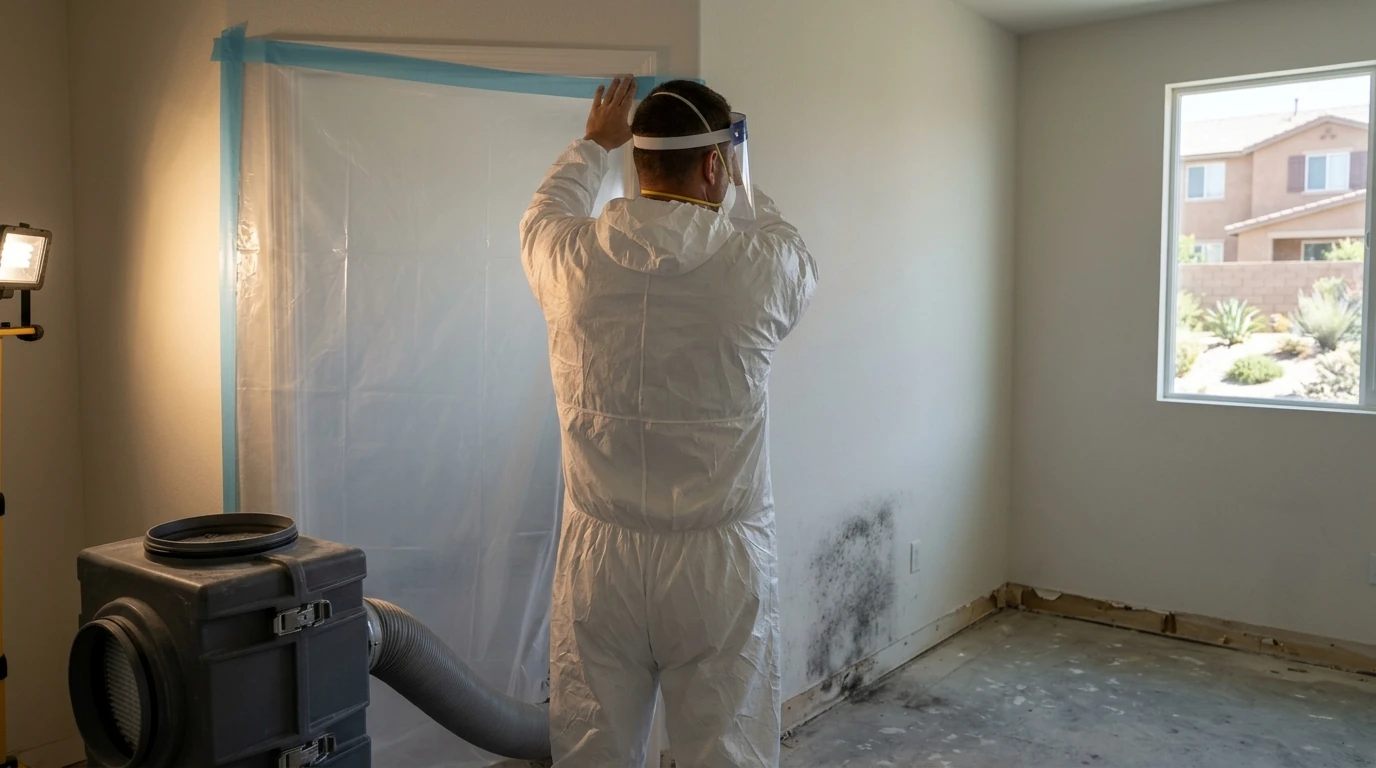
TL;DR: In Perris, CA, mold remediation typically costs $500 to $8,000, depending on how much area is affected and what caused the moisture. Small, contained jobs like a bathroom ceiling run $500 to $1,500. Whole-house jobs tied to a slab leak or HVAC contamination can reach $6,000 to $12,000. Insurance sometimes covers part of the cost when the mold followed a sudden, covered water loss, but most policies exclude mold tied to a slow, long-term leak.
If you just pulled back the baseboard in your Perris tract home and found a dark stain creeping up the drywall near where a slab leak was repaired, you’re probably bracing for a number before you call anyone. Slab leaks are common in the stucco tract homes built across Perris, Menifee, and Moreno Valley in the 1990s and 2000s, and because these homes sit on a concrete slab with no basement, the leak often runs for weeks before it ever shows up as a wall stain or a musty smell. By the time you notice it, the mold has usually had a head start. Here’s what remediation actually costs and what decides the final number.
How Much Does Mold Remediation Cost in Perris, CA?
Most mold remediation jobs in the Perris area run $1,500 to $4,500, with small single-room jobs starting around $500 and whole-house jobs involving HVAC ductwork or structural framing reaching $6,000 to $12,000 or more. The number depends almost entirely on how much material has to come out and how far the contamination has spread.
| Scenario | Typical Cost Range |
|---|---|
| Small visible surface mold (bathroom ceiling, under a sink, 10 to 20 sq ft) | $500 - $1,500 |
| Single room after a slab or supply-line leak (drywall and baseboard removal) | $1,500 - $3,500 |
| Attic or crawlspace mold from a roof or plumbing leak | $2,000 - $5,000 |
| HVAC or duct contamination spreading into multiple rooms | $3,500 - $7,000 |
| Whole-house remediation after prolonged water intrusion | $6,000 - $12,000+ |
| Mold inspection and testing only (no remediation work) | $300 - $700 |
These are typical ranges, not a quote. Every job is different, and a reputable remediation company should give you a written scope before any work starts.
What Drives Mold Remediation Cost Per Square Foot?
Mold remediation typically runs $10 to $25 per square foot of affected material, with the low end covering a quick cleanup of non-porous surfaces and the high end covering removal and replacement of drywall, insulation, and baseboard.
A few things push that number up or down. The category of water that caused the mold matters: a clean supply-line break is simpler to remediate than a slab leak that’s been sitting under the slab for months, because longer exposure means moisture has migrated further into wall cavities than it looks from the surface. Porous materials, drywall, carpet, insulation, often have to be removed rather than cleaned, while tile, concrete, and some sealed wood can sometimes be treated in place. Containment and negative air setup add labor on any job where the mold is spreading or the space connects to the rest of the HVAC system. Accessibility matters too: an attic or crawlspace job takes longer per square foot than an open bedroom wall.
If a slab leak is the suspected cause, it’s worth reading about who to call for a slab leak in Perris before the mold conversation even starts, since stopping the water source is step one regardless of what the mold ends up costing to remove.
How Much Does Black Mold Removal Cost?
Removing Stachybotrys chartarum, the dark greenish-black mold people call “black mold,” costs roughly the same $10 to $25 per square foot as other mold species, but jobs often land at the higher end of that range, typically $3,000 to $8,000, because it usually means more porous material has to come out, not just be cleaned.
There’s no special pricing tier for black mold specifically, and there’s no federal standard for a “safe” level of mold in a home, so cost is really driven by scope: how much drywall, insulation, or subfloor is affected, not which species is growing on it. If you’re trying to tell what you’re actually looking at before calling anyone, our guide on black mold vs. regular mold walks through the visual differences and why a lab test, not a glance, is the only reliable way to confirm species.
Does Insurance Cover Mold Remediation After a Leak?
Most homeowners policies cover mold remediation only when the mold followed a sudden, accidental, covered water loss, like a supply line that burst overnight, not a slab leak that seeped slowly for weeks before anyone noticed it.
That distinction matters a lot in Perris, where slab leaks are a leading cause of hidden mold. If the leak is classified as sudden and accidental, many policies will cover the water damage and at least a portion of the mold remediation, though mold coverage is often capped at a set dollar amount in the policy itself. If the leak is considered gradual or the result of deferred maintenance, the insurer can deny the claim outright. Homeowners also have a duty to mitigate once a leak is found: documenting the damage with photos and starting drying or remediation promptly helps protect whatever claim you do file, according to the Insurance Information Institute. For the fuller picture on how adjusters typically treat water losses, see our guide on whether homeowners insurance covers water damage.
What Happens During a Mold Remediation Job?
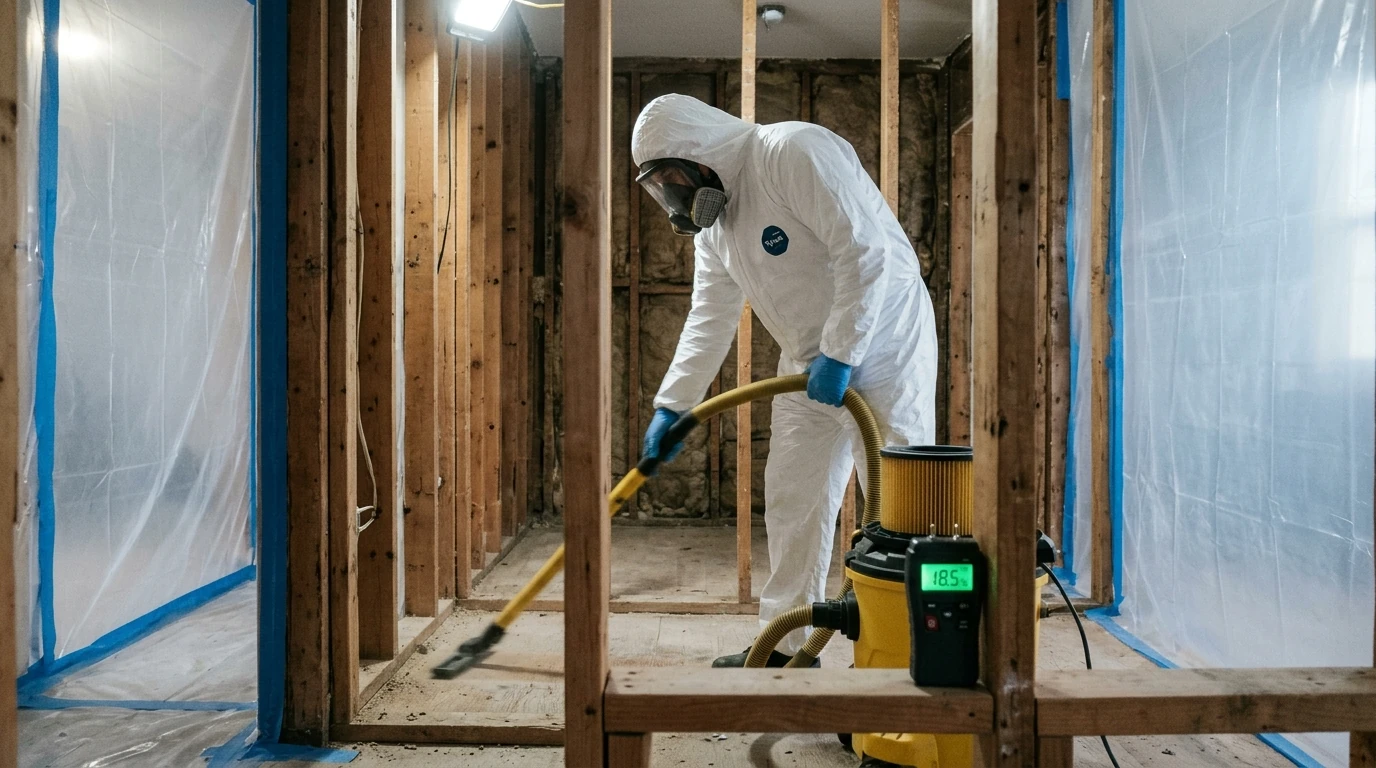
A mold remediation job follows a set sequence: inspect and map the moisture, contain the area, remove what can’t be saved, clean and treat what can, dry the space, and test to confirm it’s clear.
- Inspection and moisture mapping. A technician uses a moisture meter to trace how far the water traveled, since mold often extends beyond the visible stain.
- Containment. Poly sheeting seals off the work area and the HVAC system is isolated so spores don’t spread to the rest of the house.
- Removal of affected materials. Drywall, insulation, and baseboard that can’t be cleaned are cut out and bagged for disposal.
- HEPA vacuuming and antimicrobial treatment. Remaining surfaces are cleaned and treated following the ANSI/IICRC S520 mold remediation standard.
- Drying. Air movers and dehumidifiers bring the space back to a normal moisture level, the same way they would for any water loss.
- Clearance testing. A final check confirms mold levels have returned to a normal range before containment comes down.
Mold can start growing within 24 to 48 hours on a wet surface, according to the EPA, which is why the gap between finding a leak and starting remediation matters as much as the remediation itself.
Who Pays for Mold Remediation, and What Should You Do Next?
Who pays depends almost entirely on what caused the moisture. If the mold followed a sudden, covered water loss, your insurer may cover the water damage and some of the remediation cost. If it followed a slow leak, condensation, or deferred maintenance, the cost usually falls to the homeowner, and in a rental, to whoever is found responsible for the leak itself.
Before you commit to a number, get a written scope that spells out square footage, materials being removed, and whether clearance testing is included. Schedule a mold inspection so you’re working from an accurate measurement of the problem instead of a guess based on what’s visible.
Thunder Restoration handles mold remediation and the water leak detection that often comes before it, which matters in Perris, where the source of the moisture is frequently hidden under a slab rather than sitting in plain sight.
About Thunder Restoration
Thunder Restoration is an IICRC Certified Firm serving Perris, CA and the surrounding Inland Empire since 2007 (CSLB License #902886). Their crews handle water damage restoration, water leak detection, mold remediation, sewage cleanup, fire and smoke damage restoration, storm damage restoration, asbestos and lead-paint abatement, and reconstruction across the region, with 24/7 availability for active water and fire emergencies.
Need help now? Call Thunder Restoration at (951) 479-7038.