
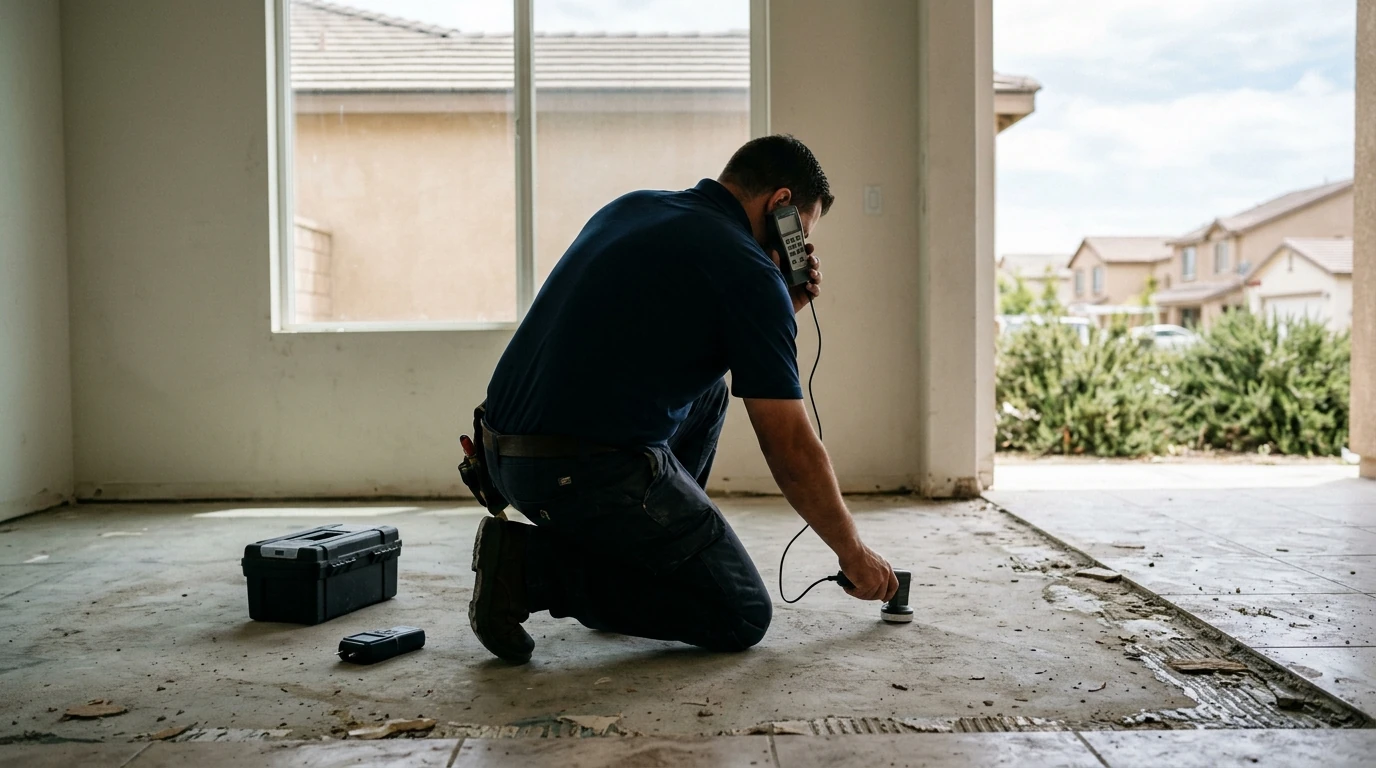
TL;DR: For a slab leak in Perris, call Thunder Restoration at (951) 479-7038 for leak detection and water damage response, not a general plumber alone. A slab leak needs electronic leak detection to find the exact point under the concrete before anyone cuts into the floor, plus moisture mapping to catch water that has already traveled under walls and flooring. Most homeowners insurance covers the resulting water damage but not the plumbing repair itself.
If you’ve noticed a warm spot on your tile floor, a hissing sound under the slab, or your water bill jumped for no obvious reason, you’re probably dealing with a slab leak, not a regular pipe break. Perris sits on slab-on-grade construction almost everywhere, which means the copper or PEX supply lines run under a concrete foundation instead of through a crawlspace. When one of those lines fails, the water doesn’t show up right away. It travels under the slab first, then surfaces through a crack, a baseboard, or a soft spot in the flooring. By the time you see it, the leak has usually been running for days or weeks.
How do you know it’s a slab leak and not something else?
A slab leak shows up as a warm or damp patch on the floor, a sudden spike in your water bill, or the sound of running water when every fixture in the house is off. Those three signs together are the clearest indicator.
Warm spots happen because most slab leaks come from the hot water line, and the heat transfers up through the concrete. If you walk the house barefoot and one section of tile or vinyl feels noticeably warmer than the rest, that’s worth testing with a moisture meter before you assume it’s nothing. A water bill that climbs 20 to 40 percent with no change in usage is another strong signal, especially paired with a water meter that keeps spinning after you shut off every tap and appliance.
Other signs include cracking in the slab itself, mold or a musty smell near baseboards, and warped flooring near an exterior wall. None of these confirm a slab leak on their own, but two or more together usually mean it’s time for a professional leak locate rather than a guess-and-cut approach.
Who do you call first: a plumber or a restoration company?
Call a restoration company with electronic leak detection equipment first if the leak is hidden under the slab, and call a plumber directly only if the source is already obvious and above ground, like a visible pipe break under a sink.
The reason for the distinction: a plumber without leak detection tools has to guess where to cut, which can mean multiple exploratory holes in your flooring before they find the actual line. A company that offers both water leak detection and emergency plumbing can pinpoint the leak acoustically or with infrared, then coordinate the repair and the water damage cleanup as one job instead of two separate calls and two separate invoices.
If you smell sewage, see standing water pooling fast, or notice electrical outlets near the wet area, that’s a different priority: shut off power to that area at the breaker if you can do so safely, and treat it as an emergency regardless of which company you call. For a flooded structure beyond a slab leak specifically, the same triage logic applies and is covered in more detail in our guide on who to call for a flooded house in Perris.
What happens when you call for a slab leak?
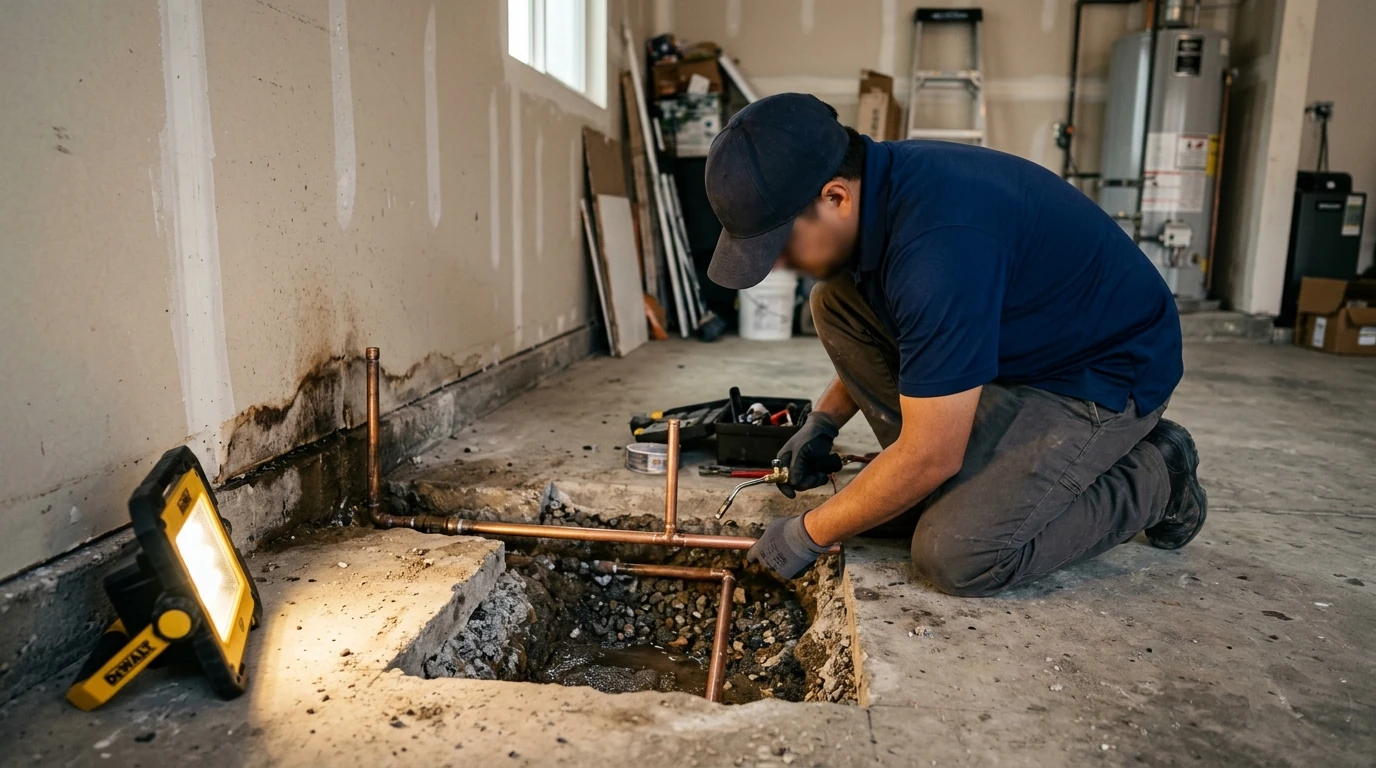
The first call is a quick phone triage: when you noticed it, where the warm or wet spot is, and whether the water is still running. From there, a technician comes out with electronic listening equipment and a thermal camera to locate the leak’s exact position under the slab before anyone touches the concrete.
Once the leak is pinpointed, you generally have two paths: a direct slab penetration to access and repair that one section of pipe, or a reroute that runs new line through the attic or walls and abandons the damaged section in place. The technician should explain both options with a written scope, not just start cutting.
At the same time, any water that already migrated under flooring or into drywall gets assessed with a moisture meter, following the IICRC S500 water damage standard for how deep the drying needs to go. Extraction and drying equipment goes in immediately if moisture readings are high, because drywall and subfloor that stay wet past 24 to 48 hours start to grow mold.
Will homeowners insurance cover a slab leak in California?
Most homeowners policies do not cover the cost of finding or repairing the leaking pipe itself, since that falls under gradual wear and maintenance, which standard policies exclude. What most policies do cover is the resulting water damage: the drywall, flooring, and drying costs caused by the leak, as long as the damage is sudden and accidental rather than something that built up slowly over months.
That split matters for your claim. Document the warm spot or bill spike with photos and dates as soon as you notice it, and get a written scope of the water damage separate from the plumbing repair invoice. The Insurance Information Institute’s guide to standard homeowners coverage explains this sudden-versus-gradual distinction in more detail, and it’s worth reading before you call your adjuster. Coverage details vary by policy and insurer, so confirm the specifics with your agent rather than assuming.
Repair or reroute: which fixes a slab leak for good?
A direct repair costs less upfront and fixes the one section that failed, but it doesn’t address whether the rest of the copper line is near the end of its life. A reroute costs more but replaces the vulnerable run entirely and avoids cutting into a slab a second time if another section fails later.
For homes built before the mid-1990s with original copper supply lines, a reroute is usually the more durable call, especially if this is the first slab leak in an older system; a second leak six months later in a different spot is common once copper starts pitting. For a newer home or a single isolated failure, a direct repair is often reasonable. A licensed contractor should walk you through pipe age, material, and the cost difference before you decide, not make that call for you.
If the water damage is contained to one room, a straightforward water damage restoration scope can usually run alongside the plumbing repair without much disruption to the rest of the house.
Once the leak is found and the repair path is set, the next step is getting both the plumbing work and the drying scope in writing before anyone starts. Thunder Restoration is a 24/7 IICRC Certified Firm licensed through the California Contractors State License Board (license #902886), and handles both the leak location and the water damage drying under one job for Perris homeowners.
About the author: This guide was written with the Thunder Restoration team, an IICRC Certified Firm licensed through the California Contractors State License Board (license #902886), serving Perris and the surrounding Inland Empire since 2007.
Need help now? Call Thunder Restoration at (951) 479-7038.