
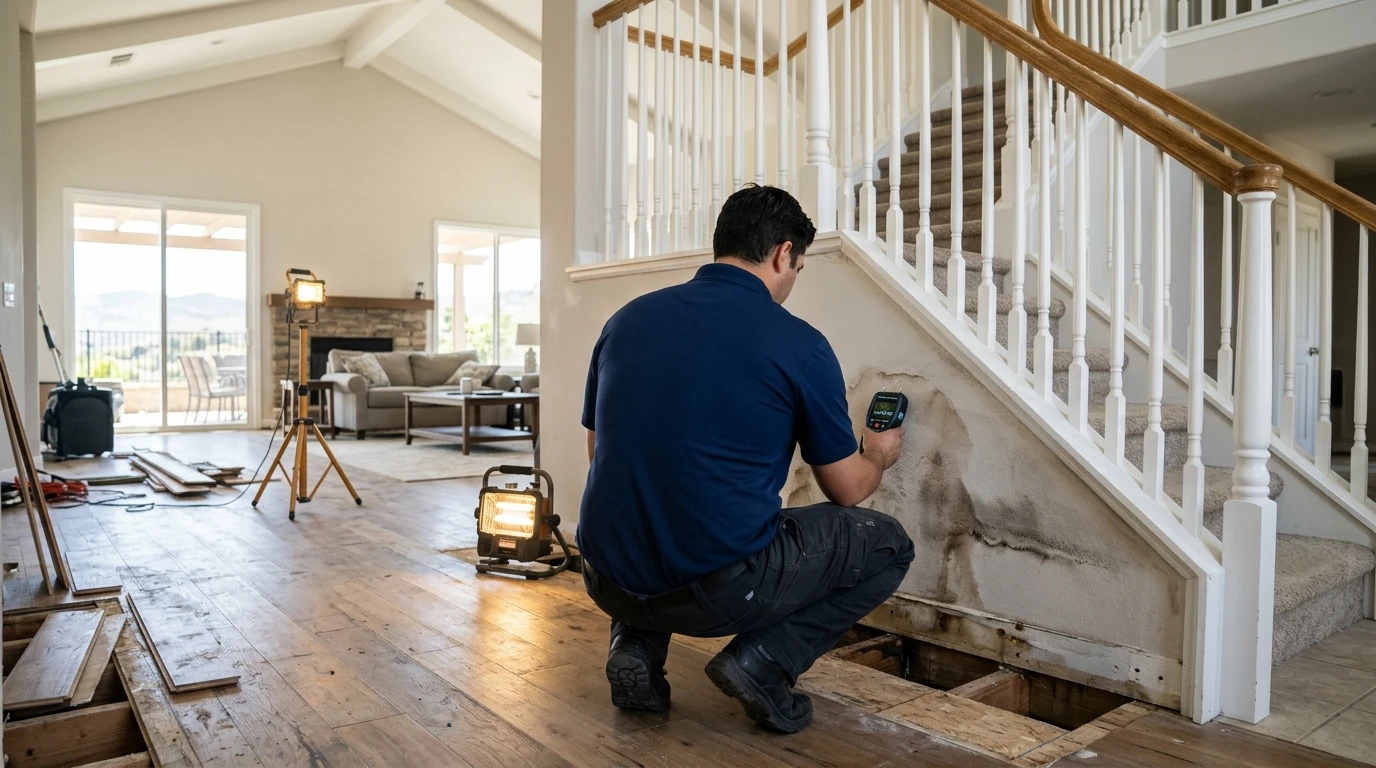
TL;DR: In Temecula, CA, water damage restoration typically costs $1,500 to $4,500 for a single affected room with clean water, and $7,000 to $15,000 or more for a multi-room loss involving contaminated water or structural drying across a two-story home. The final number depends on the water category, how much square footage is affected, and whether materials like drywall, flooring, or cabinetry need to be removed and replaced.
If a supply line let go behind the laundry room or a slow roof leak finally showed up as a stain across your vaulted ceiling, you’re probably staring at a quote and wondering if it’s reasonable. Temecula’s housing stock skews newer and larger than much of the Inland Empire, with a lot of two-story production homes and wine-country estates off Rancho California Road and De Portola Road. Bigger floor plans and higher ceilings mean more square footage to dry and more equipment running longer, which changes the math compared to a smaller single-story home.
How much does water damage restoration cost per square foot in Temecula?
Most restoration companies price water damage work by the job, not strictly per square foot, but a rough range is $3 to $8 per square foot for mitigation (extraction and drying) and $8 to $25 per square foot if drywall, baseboards, flooring, or cabinetry need to be removed and rebuilt.
A 200-square-foot kitchen with a dishwasher leak that only needs drying might land near the low end. A great room with 18-foot ceilings, hardwood floors, and water that traveled under a staircase into a downstairs bedroom, which is a layout you’ll see in a lot of Temecula’s larger two-story builds, pushes toward the high end because of the extra drying time and the built-ins that have to come out.
What determines the final water damage restoration cost?
The biggest cost drivers are the water’s contamination level, how long it sat before anyone called for help, and how much of the structure got wet.
Water is classified under the ANSI/IICRC S500 standard into three categories. Category 1 is clean water from a supply line or water heater. Category 2, also called gray water, includes washing machine discharge or a toilet overflow without feces. Category 3, or black water, covers sewage, any backup from beyond the trap, or storm-driven surface water, and it requires removing porous materials rather than drying them in place.
A Category 1 loss caught within a few hours and dried with air movers and a dehumidifier costs far less than a Category 3 loss that sat for two days and soaked into wine cellar insulation, baseboards, and subfloor under engineered hardwood. Other factors that move the price:
- Square footage and number of rooms affected (a single bathroom versus a flooded first floor)
- Materials involved (tile and concrete dry faster and cheaper than hardwood, carpet pad, or plaster)
- Response time (a 24-hour delay often turns a drying job into a tear-out job)
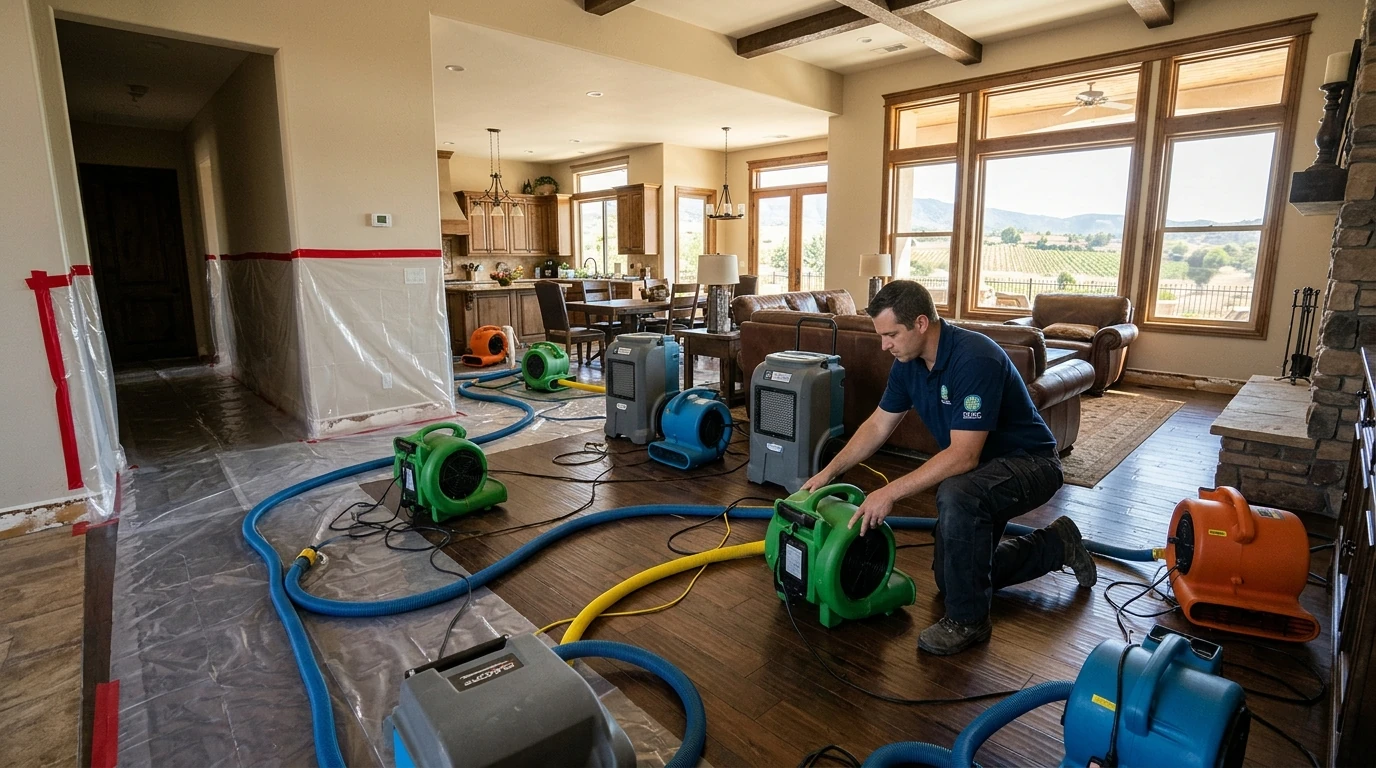
- Access and layout (vaulted ceilings and two-story construction need more equipment and more labor hours)
- Secondary damage like mold growth, which the EPA notes can begin within 24 to 48 hours on wet drywall and framing
Typical water damage restoration costs in Temecula, CA
| Scenario | Typical Cost Range |
|---|---|
| Water extraction only, single room, clean water | $500 - $1,500 |
| Structural drying, dehumidifiers + air movers (per day, equipment rental basis) | $150 - $300/day |
| Single room, Category 1, full mitigation and drying | $1,500 - $4,000 |
| Multi-room or whole-floor loss, Category 2 | $4,000 - $8,000 |
| Category 3 (sewage/black water) cleanup with material removal | $7,000 - $15,000+ |
| Mold remediation if growth has already started | add $1,500 - $6,000 |
These are typical industry ranges for the region, not a quote. Every loss is different, and a reputable company should give you a written scope of work before any demolition or drying equipment goes in.
Does homeowners insurance cover water damage restoration?
Most homeowners policies cover sudden, accidental water damage, like a burst pipe or a washing machine hose that fails without warning, but they typically exclude gradual leaks, long-term seepage, and flood water from outside the home.
A sump pump failure or a sewer backup is usually not covered unless you’ve added a specific water backup (sewer/sump) endorsement to your policy. Flood damage from rising water, including the kind that can follow heavy winter storms off the nearby hills, requires a separate flood policy through the National Flood Insurance Program or a private flood carrier, since standard homeowners insurance does not cover it. The Insurance Information Institute has a plain-language breakdown of what a standard policy typically includes.
Documentation protects your claim. Photograph the damage before anything is moved, keep every receipt, and get the mitigation started quickly since most policies require you to limit further damage. Thunder Restoration provides a written scope of work and works directly with adjusters on the documentation side, which keeps the claim moving instead of stalling on paperwork. If you’re still sorting out what your policy actually covers, our guide on what homeowners insurance covers for water damage walks through it in more detail.
What does the water damage restoration process actually involve?
A standard job runs through four phases: inspection, extraction, drying, and repair, usually in that order over several days to two weeks depending on scope.
- Inspection and moisture mapping. A technician uses a moisture meter and sometimes a thermal camera to find how far the water traveled, including inside walls and under flooring that looks fine on the surface.
- Water extraction. Standing water comes out with truck-mounted or portable extraction equipment, usually within the first few hours.
- Structural drying. Air movers and LGR dehumidifiers run for 3 to 7 days, with daily moisture readings to confirm the materials are back to a dry standard before equipment comes out.
- Repair and reconstruction. Drywall, baseboards, flooring, and cabinetry that couldn’t be saved get rebuilt. This is where a company’s general contracting and reconstruction capability matters, since it avoids handing you off to a second contractor mid-project.
If you’re in the middle of an active leak right now, our first 24 hours after water damage checklist covers what to do before a crew arrives.
What’s the best way to get an accurate cost for my situation?
The only way to get a number you can trust is an in-person moisture assessment, since photos and phone descriptions can’t show what’s happening behind the drywall.
For a water damage loss anywhere in Temecula, from Old Town to the wine country estates off Rancho California Road, call Thunder Restoration at (951) 479-7038 to schedule a moisture assessment and get a written scope before any work starts.
About Thunder Restoration
Founded in 2007, the company is an IICRC Certified Firm licensed in California (license #902886) with technicians holding IICRC Water Damage Restoration Technician (WRT) certification. Based in Perris, the crew serves the Inland Empire and Southwest Riverside County, including Temecula, Murrieta, and Menifee, with a 24/7 emergency line and services spanning water, fire, mold, sewage cleanup, and reconstruction.