
Large Loss and Catastrophic Response in Perris
24/7 large loss and catastrophic response in Perris and surrounding areas. IICRC-certified, insurance billing accepted. Call (951) 479-7038.
When a loss is too big for a single crew. A warehouse fire that spreads to adjoining units, a broken main that floods three floors of a commercial building, a storm that tears into a multi-tenant property all at once: these losses move fast, involve six and seven figure claims, and need a coordinated response from day one, not a crew that shows up and figures it out as they go. Large loss and catastrophic response is built for that scale, not for a single flooded bathroom.
What Large Loss and Catastrophic Response actually involves
A large loss is defined less by the type of damage and more by its size and complexity: multiple structures, multiple floors, mixed-use buildings, industrial facilities, or any loss where the dollar value and the logistics outstrip what a standard residential crew can handle in a reasonable timeframe. That might mean a hotel with flooding on every floor, a manufacturing plant with fire and smoke damage across several bays, or a retail center hit by the same storm system on the same night.
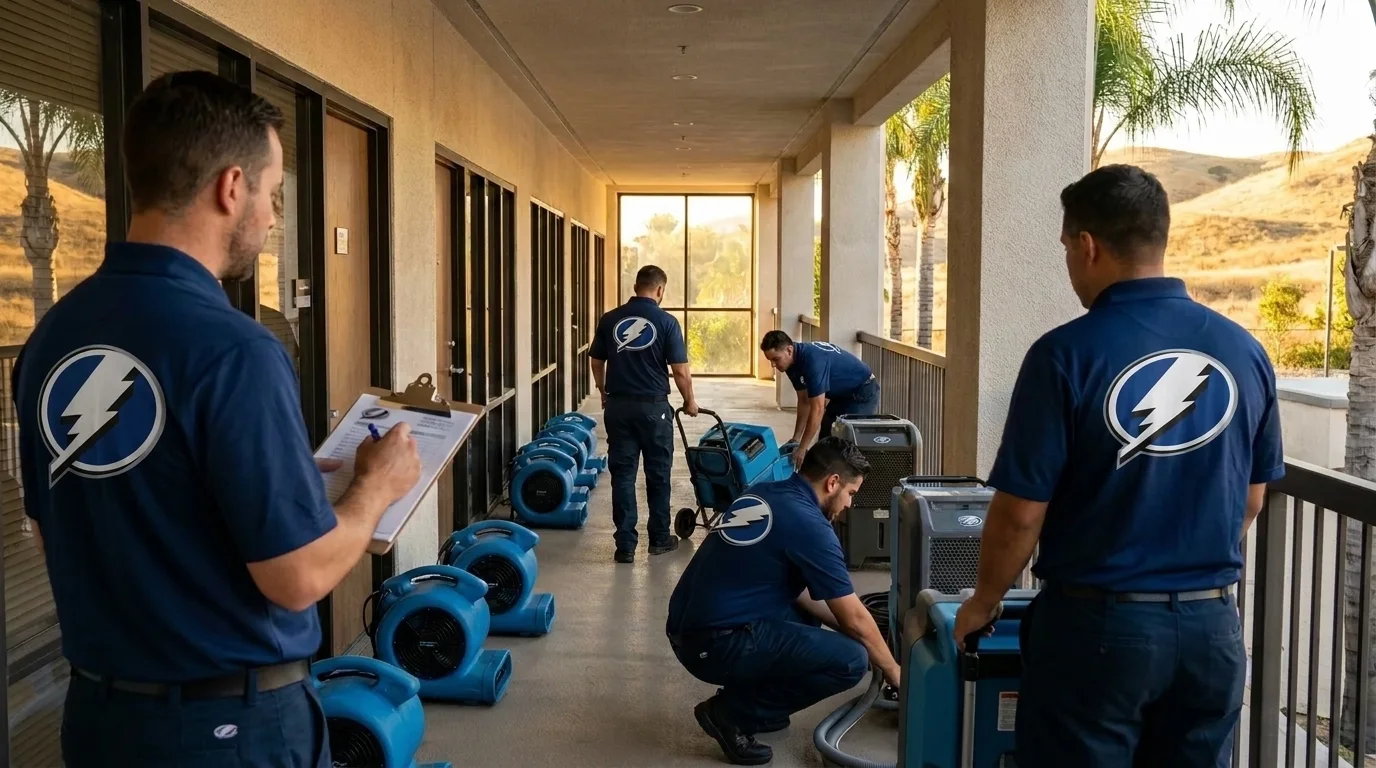
The work itself still rests on the same fundamentals: water extraction, structural drying, soot and smoke mitigation, sanitization where needed. What changes is the scale of equipment deployed (truck-mounted extraction units, dozens of air movers and dehumidifiers running simultaneously, negative air setups across multiple zones) and the amount of coordination required between property managers, multiple insurance adjusters, engineers, and sometimes several subcontracted trades working the same site at once. Timelines stretch from days into weeks depending on square footage and the number of affected zones, and documentation has to be far more granular because large claims get far more scrutiny.
Our process
- Loss sizing and scope assessment. Before any equipment gets deployed, the full extent of the damage gets mapped: how many zones, which materials, what categories of water or smoke are involved, and what the realistic mitigation timeline looks like.
- Mobilization planning. Large losses need the right number of technicians and equipment on-site at the right time, not all at once in a way that creates bottlenecks. Crews and equipment get staged by zone so drying and cleanup can run in parallel instead of in sequence.
- Phased mitigation. Work proceeds zone by zone with moisture readings, air quality checks, or soot testing logged at each stage, so progress on one floor or wing doesn’t stall because another section isn’t ready.
- Adjuster and stakeholder coordination. Because large loss claims involve bigger dollar amounts and often multiple carriers or layers of insurance, documentation gets shared on a rolling basis rather than delivered as one report at the end, so adjusters can track progress as it happens.
- Reconciliation and sign-off. Final moisture mapping, clearance readings, or air quality results get compiled into a complete record before the job is called closed, which matters for both insurance reconciliation and liability.
What separates a good large loss response from a bad one
The biggest failure point on large losses is undersized mobilization: a contractor treats a 40,000 square foot facility like a big house and sends a crew sized for residential work, which stretches the drying timeline and lets secondary damage (warping, microbial growth, corrosion) set in while equipment catches up. Another common miss is inconsistent documentation across zones, where moisture logs or photos exist for some areas but not others, which creates gaps adjusters flag during claim review.
Good large loss response means scoping the entire loss before work starts, not discovering the real size of the job three days in. It means tracking moisture and air quality data by zone so there’s a defensible paper trail if the claim gets disputed. And it means someone on-site is actively managing the sequence of trades so drying, demo, and repair don’t collide with each other on a multi-week job.
What does Large Loss and Catastrophic Response cost?
Large loss pricing depends on square footage, number of affected zones, category of water or fire damage, and how many trades need to be coordinated on-site. These are typical industry ranges, not a quote: every loss gets a written scope before work begins so the property owner and the carrier both know what’s included.
| Scenario | Typical range |
|---|---|
| Single-floor commercial water loss, under 10,000 sq ft | $15,000 - $45,000 |
| Multi-floor water loss, 10,000-50,000 sq ft | $50,000 - $200,000 |
| Industrial fire and smoke damage, partial structure | $75,000 - $300,000 |
| Multi-tenant storm damage across several units | $100,000 - $500,000+ |
| Full-structure catastrophic loss (fire, flood, or combined) | $250,000 - $1,000,000+ |
Most commercial property insurance policies cover large loss mitigation and structural drying when the cause is a covered peril, though coverage limits, business interruption clauses, and deductibles vary by policy and should be confirmed with the carrier directly.
Seasonal & regional considerations
Perris sits in a stretch of the Inland Empire where Santa Ana wind events raise wildfire exposure for commercial and industrial properties near open land, while the same dry season leaves aging roofing and drainage systems unprepared for the sudden downpours that hit during winter storm systems. Flat commercial roofs common on warehouses and light-industrial buildings in the area are especially prone to large-scale water intrusion when drains clog during a heavy rain event, which is often how a routine maintenance issue turns into a catastrophic loss affecting an entire building.
Service area
Large loss and catastrophic response is available to commercial and industrial properties in Perris and throughout the surrounding Inland Empire, including Moreno Valley, Menifee, Hemet, and Riverside.
If a loss at your property is bigger than a standard cleanup crew can handle, call (951) 479-7038 to get a large loss response team mobilized and a written scope started.
Frequently Asked Questions
What qualifies a loss as a "large loss" versus a standard claim?
Does homeowners or commercial insurance cover large loss and catastrophic response?
How many crews or technicians get deployed on a large loss job?
How long does a large loss or catastrophic restoration project typically take?
How is documentation handled differently on a large loss claim?
Looking for the best large loss and catastrophic response company in Perris?
Thunder Restoration provides licensed and insured large loss and catastrophic response in Perris, CA and the surrounding area, and has served local property owners since 2007. Customers rate us 4.5 out of 5 stars across 46 Google reviews. We answer calls 24/7 — call (951) 479-7038 for immediate help.
Need Large Loss and Catastrophic Response now?
We respond 24/7 across Perris and surrounding CA cities.