
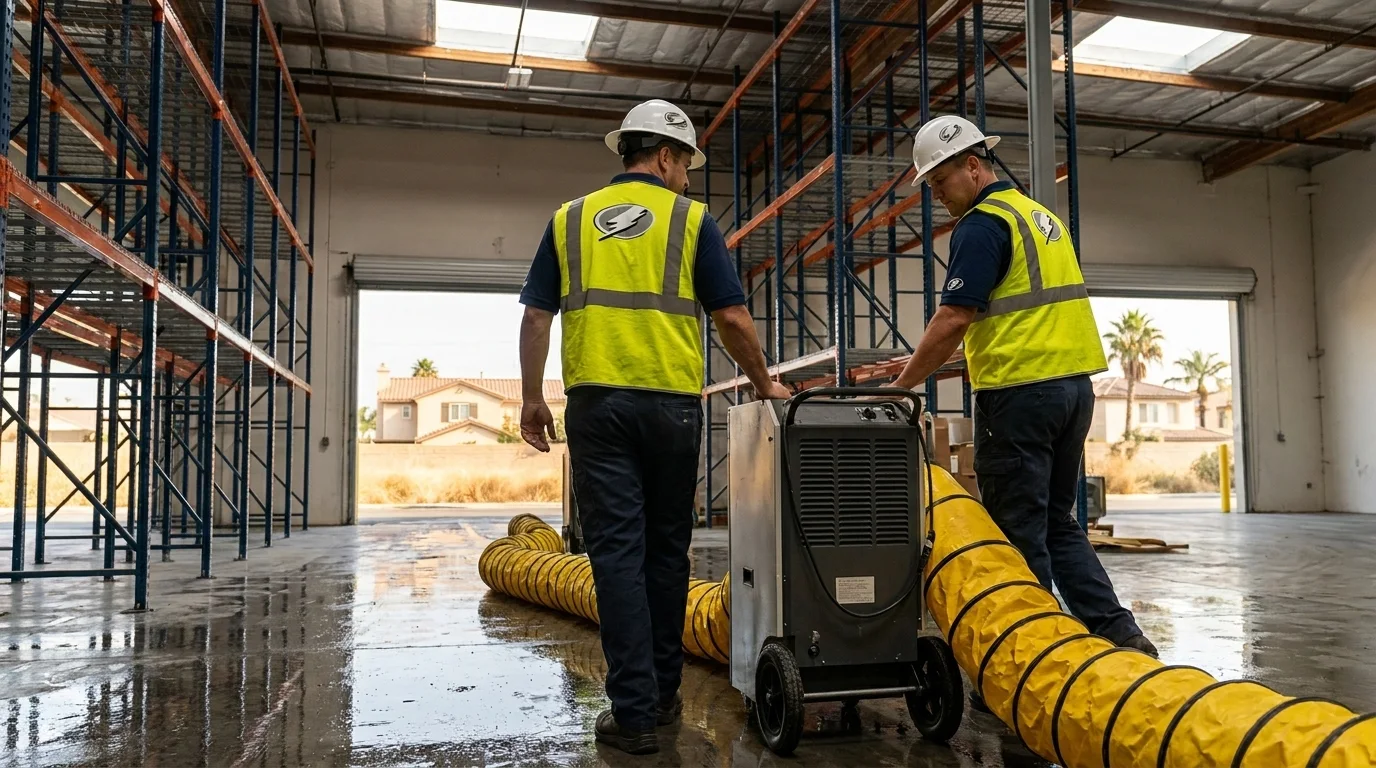
Industrial Restoration in Perris
24/7 industrial restoration in Perris and surrounding areas. IICRC-certified, insurance billing accepted. Call (951) 479-7038.
A burst line in a warehouse doesn’t behave like a residential leak. Water spreads across open-span concrete, pools under racking, and wicks into insulation above drop ceilings long before anyone notices a drop in production. By the time a facility manager sees standing water near a loading dock, the loss may already span multiple zones and shut down a line. Industrial restoration deals with that scale: large structures, heavy equipment, compressed timelines, and the pressure of keeping at least part of the operation running while the rest gets dried, cleaned, or rebuilt.
What Industrial Restoration actually involves
Industrial jobs are defined by square footage and complexity more than by any single trade. A single loss event might touch a production floor, an adjacent office pod, an HVAC or dust collection system, and a loading dock all at once, each with its own drying or cleanup requirements. Equipment used on these jobs scales accordingly: high-capacity extraction units, desiccant dehumidification for large open volumes, and moisture meters capable of reading through concrete slabs and steel decking, not just drywall and carpet pad.
Timelines vary widely depending on what’s affected. A contained water loss in one bay of a warehouse might dry out in a few days with proper equipment placement. A loss that reaches a manufacturing area with embedded machinery, electrical panels, or raw materials sensitive to humidity takes longer and often requires coordination with the facility’s own maintenance or engineering staff before restoration work can even begin. Fire or smoke events in industrial settings add another layer, since soot and heat behave differently across open-span steel construction than they do in a framed house.
Our process
- Facility assessment and loss mapping. Before any equipment goes down, we walk the affected areas, identify utility shutoffs, and map which zones are wet, which are compromised structurally, and which can stay operational during the work.
- Extraction and zone-based categorization. Water is extracted by area, with each zone categorized separately since a loading dock exposed to groundwater intrusion is a different category of loss than a clean supply line break in an office pod.
- Large-volume structural drying and monitoring. Industrial dehumidification and air movement equipment is placed based on cubic footage, not room count, and moisture readings are logged across slabs, steel framing, and insulation until materials reach dry standard.
- Equipment and materials coordination. Where machinery, inventory, or sensitive materials are involved, we coordinate drying and protection around what the facility’s own staff or vendors need to inspect or move first.
- Phased documentation and reoccupation. Photo and moisture-log documentation is organized by zone so sections of the facility can be cleared and returned to use as they’re completed, rather than waiting on the entire building.
What separates a good Industrial Restoration response from a bad one
The most common mistake on large facility losses is treating the whole building as one drying zone instead of documenting and monitoring each affected area separately. That shortcut causes two problems: moisture gets missed in spots that read dry at the surface but stay wet under slab coverings or behind equipment bases, and insurance adjusters have a harder time verifying what was actually affected versus what wasn’t.
Another common gap is ignoring HVAC and dust collection systems that moved moisture or contaminants into areas that otherwise look untouched. A good response checks those systems early rather than assuming the damage stopped at the visible water line. Adjusters reviewing industrial claims typically want zone-by-zone photo documentation, moisture logs tied to specific readings and dates, and a clear scope showing what was dried in place versus what required removal and replacement. Work that skips that documentation tends to create disputes later, even when the restoration itself was done correctly.
What does Industrial Restoration cost?
Costs on industrial jobs vary more than almost any other type of restoration work, since square footage, number of affected zones, and whether machinery or inventory is involved all change the scope significantly. The ranges below reflect typical industry figures for comparable losses, not a quote, and every facility gets a written scope of work before anything begins so there are no surprises once drying or repairs are underway.
| Scenario | Typical range |
|---|---|
| Localized water loss, single bay or office pod | $5,000 - $15,000 |
| Multi-zone water damage across a warehouse floor | $20,000 - $75,000 |
| Smoke or fire damage, limited to one production area | $30,000 - $100,000 |
| Large-loss event affecting multiple systems or full plant shutdown | $100,000+ |
Commercial property policies typically cover sudden water, fire, and storm losses to the structure and sometimes business interruption, but coverage for equipment, inventory, or pre-existing conditions varies by policy and often requires separate documentation.
Seasonal & regional considerations
Perris sits in the Inland Empire’s logistics and manufacturing corridor, where slab-on-grade warehouses and distribution centers are the dominant building type. Summer heat puts extra load on HVAC systems that are already working to manage humidity across large open volumes, which can mask or worsen moisture problems if a leak goes unnoticed for even a day or two. Santa Ana wind events also raise fire risk around industrial sites with exposed storage or loading areas, something facility managers in this region plan around more than most.
Service area
We work with warehouses, manufacturing plants, and distribution facilities throughout Perris and the surrounding Inland Empire, including Moreno Valley, Menifee, Lake Elsinore, and Hemet.
If a facility is dealing with water intrusion, fire damage, or any loss affecting production space, call (951) 479-7038 to schedule an industrial facility assessment and get a written scope before work begins.
Frequently Asked Questions
Does commercial or industrial property insurance cover this kind of restoration?
Can part of our facility stay operational while restoration work is happening?
How is water damage in a warehouse different from a typical residential water loss?
What happens to machinery or inventory during a water or fire loss?
How long does restoration take for a large industrial facility?
Looking for the best industrial restoration company in Perris?
Thunder Restoration provides licensed and insured industrial restoration in Perris, CA and the surrounding area, and has served local property owners since 2007. Customers rate us 4.5 out of 5 stars across 46 Google reviews. We answer calls 24/7 — call (951) 479-7038 for immediate help.
Need Industrial Restoration now?
We respond 24/7 across Perris and surrounding CA cities.