
For mold in your house in Menifee, CA, call Thunder Restoration at (951) 479-7038. The company is an IICRC Certified Firm that answers 24/7 and holds a 4.5-star Google rating from local homeowners, so there’s no wrong hour to ask a question about what you’re looking at on the wall.
But “call a mold company” isn’t always the full answer. If you just found a dark patch behind a dresser in a Heritage Lake townhome, or your Audie Murphy Ranch builder-grade bathroom fan has been struggling against inland Southern California humidity for a year, the right first call depends on what’s actually happening in the house.
Should You Call a Mold Remediation Company or a Mold Inspector First?
Call a remediation company when you can already see or smell mold; call an independent inspector when you only suspect it and want testing before anyone touches the wall. A remediation company removes contaminated material and treats the area. An inspector collects air or surface samples and sends them to a lab, which tells you what species are present and whether levels are elevated compared to outdoor air.
Many Menifee homeowners skip straight to testing when a patch is small and visible, since a trained technician can usually confirm visible mold by sight and moisture reading alone, no lab needed. Testing earns its cost in two situations: there’s a musty smell with no visible growth (hidden mold behind a wall or under flooring), or you need a third-party report for an insurance claim or a real estate transaction. Mold inspection and testing is a separate line item from remediation for exactly this reason: one confirms the problem, the other fixes it.
What Kind of Mold Problem Determines Who You Call First?
What you call first depends on whether the water source is still active. If a pipe, roof, or appliance is actively leaking, call a plumber or your restoration company’s water team before anyone discusses mold removal, because mold keeps regrowing until the moisture source is shut off.
A few common Menifee scenarios:
- Active leak plus visible growth (a slow drain leak under a kitchen sink that’s left a black ring on the cabinet floor): call a company that handles both water mitigation and mold, so one crew stops the source and treats the contamination in the same visit.
- Visible mold, no active leak (a bathroom with chronic condensation and a musty smell): call for mold remediation directly. The job is containment, removal of affected material, and HEPA cleaning under the ANSI/IICRC S520 standard.
- No visible mold, just a smell or past water history (a home that had a slab leak repaired six months ago and now has a stale odor returning each summer): start with testing, not demolition.
- Mold discovered during a remodel or after buying a home: an inspector’s report gives you documentation before anyone opens a wall, which protects both the budget and any dispute with a seller or contractor.
If you’ve already read our post on signs of hidden mold, you know a musty smell with no visible source is the most common reason Menifee homeowners call for an inspection rather than a crew.
What Happens When You Call?
The first call is a short conversation about what you’re seeing, where, and for how long. Have the approximate size of the affected area, whether there’s been a known water event (a leak, flood, or roof failure), and whether anyone in the house has respiratory sensitivities. That lets the technician triage whether this is a same-visit remediation job or a testing visit first.
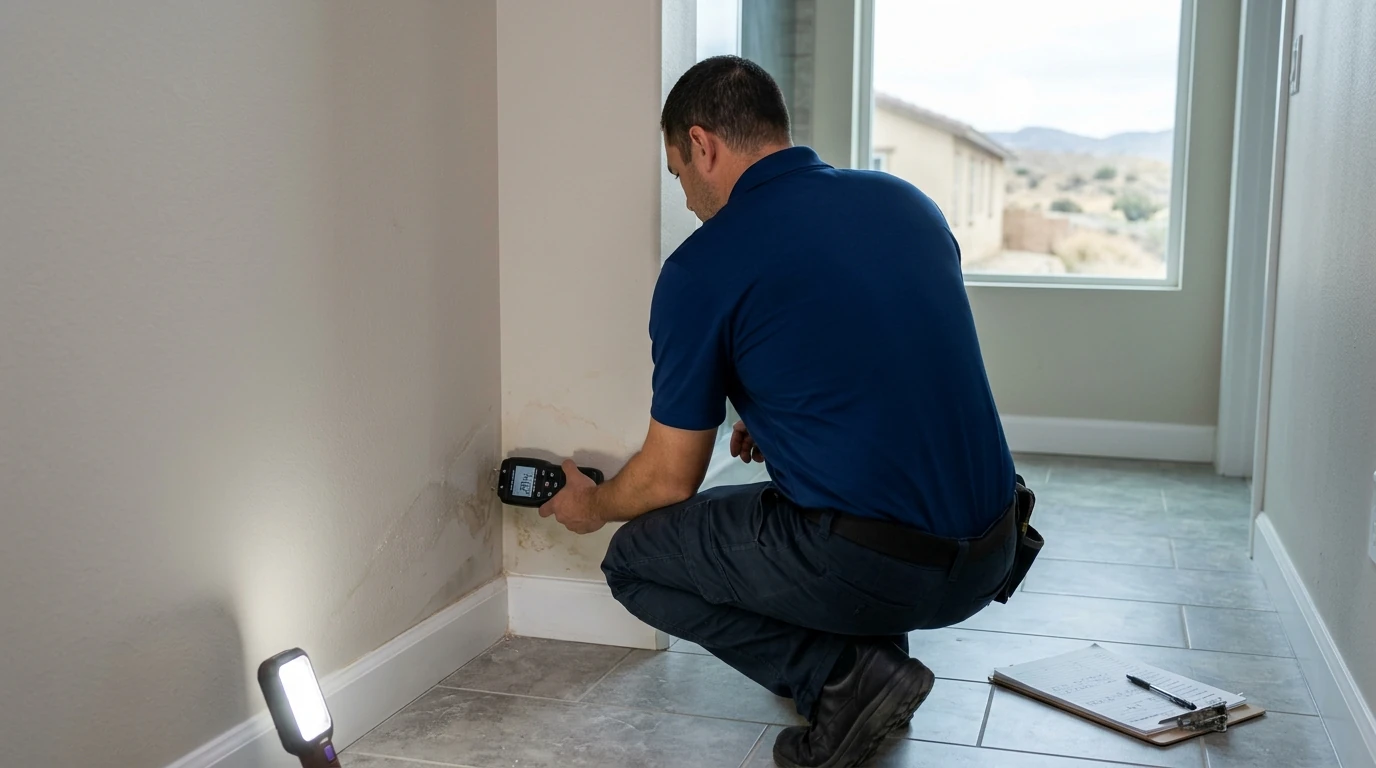
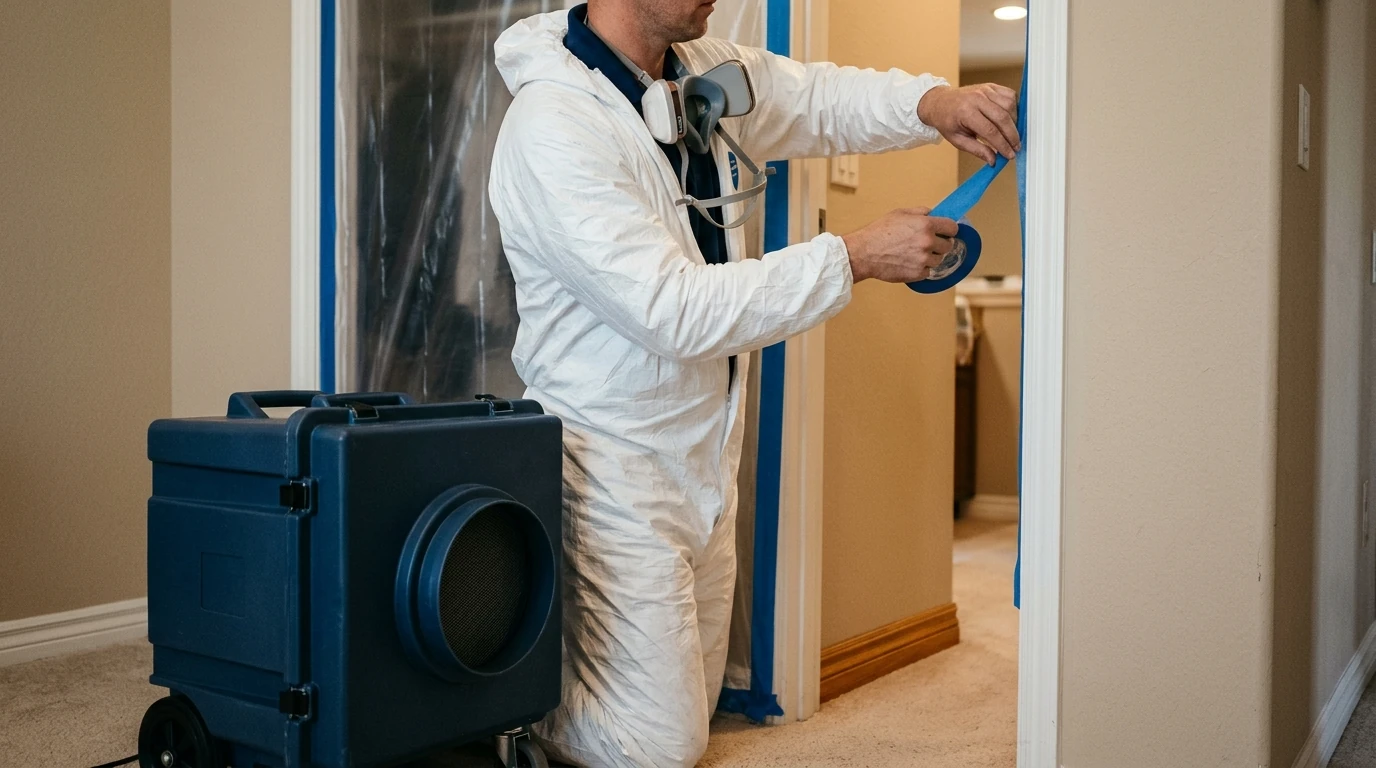
On arrival, a technician inspects the area with a moisture meter, checks adjacent materials the mold may have spread into (behind drywall, under baseboards, inside cabinetry), and explains the scope before any work starts. For confirmed remediation work, the crew sets up physical containment with poly sheeting, runs a HEPA air scrubber to control airborne spores, and removes and bags contaminated porous material like drywall or insulation rather than trying to clean it in place. Non-porous surfaces get treated and cleaned instead of removed.
Write scope and photo documentation protect you if you’re filing an insurance claim. Most homeowners policies have limited or capped mold coverage, and typically only when the mold traces back to a sudden, covered water loss rather than long-term humidity or a maintenance issue, per the Insurance Information Institute. A written scope of work before anything is removed gives your adjuster something concrete to review.
Is Mold After a Leak Always Something to Worry About?
Mold after a leak is worth addressing quickly but it isn’t automatically a crisis. The EPA notes mold can begin growing on wet materials within 24 to 48 hours, which is why drying a leak fast matters more than which mold species eventually shows up.
Not every dark patch is the toxic “black mold” people worry about online. Several common household molds appear dark and get mistaken for Stachybotrys, which is genuinely more concerning when it does occur but is far less common than people assume. You can’t reliably tell species apart by color alone, which is the practical argument for testing over guessing; our black mold vs. regular mold post walks through the visible differences people usually ask about. Either way, the health-relevant question isn’t the species, it’s exposure: how much, how long, and whether anyone in the home has asthma, allergies, or a compromised immune system.
If a Menifee leak was recently repaired and you’re now seeing or smelling something in that spot, that’s the moment to get it looked at, not a six-month wait to see if it gets worse.
Mold that started from a plumbing leak, an AC condensation line, or a roof intrusion rarely resolves on its own. A quick assessment tells you whether you’re looking at a contained, half-day job or something that’s traveled further than the visible spot suggests.
About Thunder Restoration
Thunder Restoration is an IICRC Certified Firm serving Perris, Menifee, Riverside, Moreno Valley, and the surrounding Inland Empire since 2007, operating under CSLB License #902886. The company’s crews handle mold remediation, mold inspection and testing, water damage restoration, fire and smoke restoration, sewage cleanup, and related reconstruction work across the region, available 24/7 for active water and mold issues.
Video Transcript
Found mold in your Menifee home? Call Thunder Restoration at (951) 479-7038, an IICRC certified firm available 24/7. But calling a mold company isn’t always the full answer. The right first call depends on what’s actually happening in your house. See or smell mold already? Call a remediation company. Only suspect a hidden problem? Call an independent inspector to test first. A remediation crew removes contaminated material and treats the area, while an inspector collects samples and sends them to a lab. Still dealing with an active leak? Call your water restoration team first, since mold keeps returning until the moisture source is fixed. Visible mold with no active leak calls for remediation directly. Just a musty smell with nothing visible? Start with testing instead. A technician checks moisture levels, inspects nearby materials for spread, and explains the full scope of work before anything begins. Containment, HEPA air scrubbers, and careful removal of contaminated material follow established standards, with photos that help document any insurance claim. Not every dark patch is toxic black mold, and you can’t tell species apart by color alone, so testing beats guessing every time. Don’t wait on a stain that keeps spreading. Call Thunder Restoration at (951) 479-7038 to schedule an assessment.